


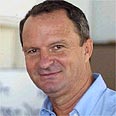
Israel's favorite mayor
Ynetnews talks to Zeev Bielski about his secret to making Raanana one of Israel's leading cities
Zeev Bielski has spent the past 16 years making Raanana one of Israel’s leading cities. With the exception of Jerusalem, there is no city in such demand by English-speaking residents as Raanana.
The city was founded in the early 1920s by 300 settlers from the United States. Today, it has 75,000 residents, 10 percent of whom are English-speaking.
Bielski’s personal approach has made Raanana a winning choice for young religious and secular families, offering excellent education, rich cultural events and job opportunities.
1. You are now in your fourth term as Raanana mayor, winning 80 percent of the vote in the last election. How have you managed to maintain your popularity without anyone accusing you of monopolizing the job?
I am lucky enough to be working in a job that I love. As often as I can, I get out of the office and meet people in the city streets and students in the schools. Their comments, compliments and complaints are all important feedback for me. And not just for me. All municipal employees take great pride in their work, looking constantly to improve services, increase efficiency and answer the needs of the public they serve.
This “listening ear” approach has earned us the respect and support of the residents and has led, in turn, to a situation where the residents themselves are active partners in improving the quality of life in the city by participating in projects related to cleanliness, recycling, etc.
2. Uniquely in Raanana, religious and secular residents live peacefully in coexistence. Why?
In Raanana we are blessed with exceptional residents, religious and secular, who live side by side in mutual tolerance and respect. Our schools promote these values of peaceful coexistence and accepting the “other,” with educational and cultural programs that bring together religious and secular students.
3. It is said the city has an “Anglo” way of life. Do the English-speaking residents influence the city in any way, and if so, how?
Raanana was founded over 80 years ago by pioneers from the U.S. who came to live the Zionist dream. Since that time, Raanana has welcomed new immigrants from all over the world, with many of them coming from English-speaking countries. These immigrants have contributed in a positive way to the development of the city, particularly in the area of volunteerism. Many of the 80+ volunteer organizations in the city are manned by English-speaking residents, who help all sectors of the community.
4. The city’s website states you undertake to answer any complaint by a resident within 48 hours from the moment the letter, call or e-mail is received. What is the strangest complaint you have ever received?
I value the direct contact I have with residents and the wider community, especially via email, and I personally answer every letter, in Hebrew or English. Residents can also turn to the Public Appeals Commissioner or to 107, the 24-hour municipal hot line that handles over a quarter of a million calls a year.
5. Raanana takes pride in the fact it offers one of the highest qualities of life in the country and has won numerous awards for its activities in promoting environmental awareness. However, you also support the development of the Etgarim Industrial park, Raanana’s “Silicon Valley,” literally across the road from the central residential area. How are you planning to maintain a balance?
The development of the high-tech business park in
Raanana has been a significant achievement over the past 10 years. We have succeeded in attracting major international high-tech businesses into the city, such as SAP, Amdocs, Nice, Retalix and Comverse.
However, these industries, unlike the traditional factories that once populated the industrial area, do not pollute the environment. On the contrary, they contribute to the city by offering hundreds of job opportunities to Raanana residents on their doorstep.
6. Raanana has six twin cities spanning Europe, Taiwan and the U.S. Have you ever been turned down by certain cities because you are from Israel?
We place much importance on our sister-city program, which allows us to participate in youth, cultural and sports exchanges, promote bilateral business ties and foster a better understanding of Israel overseas. In 2001, we became Atlanta, Georgia’s, 18th sister-city, no mean feat when you consider the difference in size between our two cities! We do not actively seek new sister cities but prefer to deepen the connection we have - a connection that dates back as many as 40 years, with Opsterland in Holland.
7. You continue to support Israeli-Palestinian dialogue especially in a time of deep political conflict and violence. "Pace of Peace," an animated movie created jointly by Raanana and Qalqilya high school students won the "Culture of Dialogue" award at the Venice Film Festival in September and was screened at an international animated movie festival in Rome in December. Do you have other projects lined up in the near future to attempt to strengthen communication and cooperation between Israelis and Palestinians?
I believe that joint projects such as the animated movie, which bring together Israeli and Palestinian youth, represent the beginnings of a dialogue between our peoples. This particular project was sponsored by the Rome Municipality’s Office for Peace in Jerusalem, and we are currently exploring ideas for another program.
In addition to this, a group of students from Raanana, Verona and Bethlehem recently met for the second time in a fascinating three-way encounter that serves to highlight the similarities between youth of different cultural backgrounds rather than dwell on political issues that divide. Further cooperation among the three schools is planned for this coming year.
