


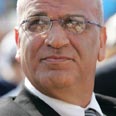
Chief negotiator Saeb Erekat
צילום: תומריקו
NATO delegation visits Ramallah
Representatives meet PA foreign minister, chief negotiator, insist group not seeking 'security role'
RAMALLAH - A NATO delegation met Palestinian Authority officials for the first time on Thursday, a new step which the Western alliance insisted did not mean it was seeking a security role in Middle East peacemaking.
"The purpose of this visit was to establish communications with the Palestinian authorities and the other aim of the meeting was to inform the minister about current NATO policies," NATO delegation head Ed Kronenburg said after talks with Palestinian Foreign Minister Nasser al-Kidwa.
"I think on both counts it's been a successful visit," Kronenburg, a Dutch diplomat and a director in NATO Secretary-General Jaap de Hoop Scheffer's office, told reporters in Ramallah.
No security cards
De Hoop Scheffer has in the past urged NATO to be ready to support any Arab-Israeli peace accord if invited. NATO held its first top-level talks on the conflict at a ministerial meeting in April.
But Kronenburg, speaking after talks later with Palestinian chief negotiator Saeb Erekat in Jericho, said the secretary-general had indicated a NATO security role in the peace process "was not in the cards for the time being".
The alliance is aware that any role, even a minor one such as training Palestinian security forces, could be viewed with mistrust in the Arab world and with displeasure by Israel, with which it is nurturing cooperation.
De Hoop Scheffer has stressed any future NATO presence would have to be requested by both parties and have a U.N. mandate.
"I also have made it very clear to my interlocutors today that NATO is not seeking a role for itself in the peace process," Kronenburg said.
Gravity shift
NATO wants to shift its center of gravity eastwards from its Cold War role of protecting western Europe from the Soviet threat. It leads an 8,000-strong peacekeeping operation in Afghanistan and has a small army officer training unit in Iraq.
Last year it relaunched its so-called "Mediterranean Dialogue" on cooperation with Arab states and Israel after the initiative attracted patchy interest in its first 10 years.
U.S. Secretary of State Condoleezza Rice led a debate among NATO foreign ministers on the Middle East at a meeting in April. They agreed that Israeli plans to evacuate settlers from Gaza were key to progress.
German Foreign Minister Joschka Fischer said then that it could not be excluded that NATO might be called on to provide security guarantees for any peace moves but added it was too early to start any operational planning.
