


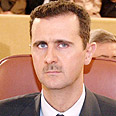
Assad has made every possible mistake
צילום: אי פי איי
Don't save Assad
The Ba'athist regime in Syria is moribund. Israel should let the U.S. finish it off
First of all, let it be known: This writer is not part of the "Whole Land of Israel" faithful.
In addition, I also believe that at the end of the day, Israel will be forced to make some territorial compromise on the Golan Heights.
But at the same time, at this moment, Israel absolutely must not throw Syria a life-saving rope. And not even - perhaps especially not because - the Syrian president is weaker than ever.
From the time he came to power, Bashar Assad has made every possible mistake. Recently, he even managed to forge a U.S.-French alliance against him, and French President Jacques Chirac, who lost a close friend and sponsor in last February's assassination of Lebanese leader Rafik Hariri, had some not-exactly-diplomatic words for his former ally.
It appears at the moment that following the publication of the international investigation into the Hariri murder, the international community will rise up with one voice against Damascus, with a long list of demands.
If anyone had any doubts that Syria was next on George Bush's list, the president's latest speech will have removed those question marks.
Let's see: Iraq fell and Saddam Hussein's trial is about to start; Afghanistan is recovering slowly and is even considering the possibility of recognizing Israel; Libyan leader Muamar Qadaffi has embraced the West and is voluntarily giving up forbidden weapons; North Korea is ready to re-sign the nuclear Non-Proliferation Treaty, if only with pre-conditions.
There are only two members of Bush's "axis of evil" left: Iran and Syria. And he blames them for nothing less than the murder of American citizens.
One could degrade the Bush administration's policy since September 11 (for or against us? Friend or enemy? Black or white?) and also scorn the appearances of the world's only (for the moment) superpower.
One could also claim they came here unprepared for our explosive quagmire, that they are playing with fire and have already plunged the entire region into a never-ending swirl of terrorism and blood.
But one thing can't be taken away from them: The double standard they left behind. The days of despotic rule in Latin America and the Middle East are gone, the days of fear about the stability of oil exports, the days of no civil rights and political freedom, all in the name of "stability."
In the black-and-white word of Dick Chaney and Donald Rumsfeld, stability is no longer a cover for everything (not even, you'll be surprised to know, for oil).
Golden bridge to the White House
After Iraq, Assad is no longer a roaring lion, but rather easy prey. The question is no longer how complicated it will be for the Americans to throw him and his henchmen in the trash bin of history, but rather, what will happen to Syria afterwards.
There are only two ways this bleeding cub can save his skin: One, with a complete U-turn and complying completely with American dictates, a la Qaddafi's Libya (including closing Hamas and Islamic Jihad offices, sealing the border with Iraq, preventing Iranian weapons from reaching Hizbullah, and perhaps even liberalizing the country's politics and economics).
The other, preferred, option would be to return to the negotiating table with Israel. This would gain him a life raft that would build him a golden bridge all the way to the White House (and if not with "official" Israel, then at least with a few Knesset members, like the Geneva Initiative).
However, since the Hariri assassination, Bashar's statements about renewing negotiations "with no preconditions" or "from the point where they left off" have weakened a bit.
And still, every now and again we hear something about some representative (mostly from Assad himself) trying to scope out possibilities, or about some international body meant to convene (mostly a British idea).
What should Israel do with all this? Nothing.
Israeli society is still licking its wounds from the Gaza disengagement (those of you who are convinced the move was not traumatic should go ask Maj. Gen. Elazar Stern or acting Finance Minister Ehud Olmert about their experiences at the Western Wall and in a synagogue recently).
In any event, we cannot pay the price of peace with Syria at the moment. To the contrary, attempts to do so at the present time will lead to nothing – and will only go to serve the moribund dictatorship in Damascus.
More than that, Bahsar 2005 is a far cry from late Egyptian leader Anwar Sadat 1977.
In theory, it should be easy to get Assad to agree to a good deal because he is weak. But a contract with a weak and isolated leader, who has hit a dead end in every possible area, and whose country is weaker than Israel in every measure of strength, could well not be worth the paper it's printed on.
True, Israel was created to be a peace broker. Our Declaration of Independence "offer(s) peace and unity to all the neighboring states and their peoples".
But this time, there is no choice: if any when a proposal comes, we must reject any overture from Assad.
Israel must not go over the American's heads; we must let them finish the job.
And one more recommendation, this time for the geniuses of our intelligence community and the foreign ministry: To quote the Mishna, "silence is a protective fence for wisdom."
Public declarations about the "suicide" of Ghazi Kenaan the man who knew too much, or about the imminent demise of Bashar Assad himself, serve neither our, nor George Bush's, interests.
Guy Ronen is an editor at Ynet (his views do not necessarily represent Ynet)
