


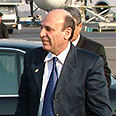
Defense Minister Shaul Mofaz in Cairo
צילום: חנן גרינברג
Mofaz: No peace with Abbas
Defense minister pessimistic about prospects of peace with current Palestinian leadership
On Wednesday Defense Minister Shaul Mofaz held a rather unpleasant conversation with Egyptian President Hosni Mubarak in Cairo.
“Now, as we sit here at 10:30 a.m., the Palestinian terror organizations are attempting to carry out five suicide attacks in Israeli population centers,” Mofaz told Mubarak; five hours later a suicide bomber blew himself up at the Hadera market.
Mofaz tried to convey to Mubarak Israel’s disappointment with its Palestinian partner.
“Abbas is a ‘one man show,’” Mofaz said. “There is a void; a governing void. In actuality, there is no one to talk to. Abbas and his PA colleagues are driving in neutral; they haven’t even shifted in to first gear yet; they have done nothing.”
Mubarak, for his part, tried to lighten the mood by praising Ariel Sharon; the president still contends that Sharon is the only Israeli politician who is capable of bringing an end to the Israeli-Palestinian conflict.
“This is true,” Mofaz replied, “but now it is the Palestinians’ turn to live up to their end of the bargain – Sharon has already done what nobody believed he would.”
At the end of that very long day, Mofaz, who was back in his office in Israel, said in a moment of candor, “I am not certain we may ever be able to reach a peace agreement with the current Palestinian leadership; we will have to wait for the next generation.
“The best we can hope for in the meantime is perhaps another interim agreement. A Palestinian state? A final agreement? I don’t see this happening in the coming years,” he said.
“I am very interested in reaching an agreement, but we must face the fact that the Palestinian partner is not delivering the goods.”
The prime minister does not plan on evacuating any more settlements in the months leading up to the Knesset elections. He will refrain from carrying out such a move not because of the upcoming elections, but rather because he too contends there is no one to talk to on the Palestinian side.
Abbas traveled to Washington to collect part of the reward for the recent pullout, but as far as Sharon is concerned, the Palestinian leader deserves nothing.
Netanyahu isn’t coming
But it is not only the Palestinian partner that Sharon is disappointed with; following his victory in the Likud Central Committee vote, the prime minister asked his colleagues to support him and begin acting as a united faction in Knesset.
But as early as next week, with the opening of the Knesset’s winter session, Sharon will once again have to engage in a battle against his enemies from within, led by “rebel” leader Benjamin Netanyahu, who will seize every opportunity to wave his finger and say, “I told you so.”
The “rebels” still have contempt for Sharon, who they believe has ignored and disrespected them throughout his term.
Sharon, on the other hand, did not make a worthy effort to appease his opponents. While he did meet with a few of them, he did not offer them a place in cabinet.
On Tuesday, during a meting between Sharon and Knesset Member Gideon Sa’ar, the coalition chairman who confronted him by supporting Netanyahu’s call for early Likud primary elections, the prime minister proposed to let bygones be bygones and focus on the future.
But Sharon could not resist asking Sa’ar, “why did you want to banish me?”
With this remark he proved that peace within the ranks is still very far off.
The first confrontation is already upon us: Next week a vote will be held on the appointment of Deputy Defense Minister Zeev Boim and MK Ronnie Bar-On to ministerial positions and Ehud Olmert’s position as permanent finance minister.
“It may end in a farce, a major embarrassment to the prime minister,” a senior Likud member who is not a Sharon supporter said. “I suggest he separate between Olmert’s appointment and that of Bar-On and Boim.”
Netanyahu is preparing for a “High-noon”-type duel. In conversations with MKs he urges them to vote against the appointments, adding that he too will oppose them. If Sharon hoped for a united faction, in the first week he’ll already see his objectors go back to their usual behavior.
Sunday evening, Likud Knesset members and their partners will arrive for a “let’s get closer” meeting at the prime minister’s official residence in Jerusalem. Some of those invited, including former Finance Minister Benjamin Netanyahu said they will now show up.
Sources close to Netanyahu say “there is no room now for such artificial projects. Instead of occupying himself with such events, it’s time for Sharon to formulate Likud principles.”
This Knesset session will likely be its last one, where it will decide to bring forward general elections. Until it ends, we can assume it would be a very heated session, where all gloves off.
Halutz vs. Diskin
The terror attack in Hadera shows how difficult it is to declare a winner in this conflict, not even by points.
The meeting convened by Mofaz Wednesday evening at his office in IDF headquarters in Tel Aviv, where responses to the bombing were weighed, brought forward all the familiar arguments – only the faces have changed.
Shin Bet Chief Yuval Diskin, as opposed to his predecessor, Avi Dichter, warned against getting carried away with operations that would drag all Palestinian terror groups back to the battle field. Chief of Staff Dan Halutz, as opposed to his predecessor, Moshe Yaalon, supported heavy blows anywhere, against any target.
Diskin suggested focusing on the Islamic Jihad and avoiding actions that could hurt the Palestinian population and anger it. On the other hand, Halutz said: “If we sustain casualties in the Hadera market, I suggest that we don’t take humanitarian aspects into consideration. Even one person killed on our side makes consideration for the Palestinians not worthwhile.”
Mofaz sought a middle ground between the two. The defense minister believes the Israeli response must focus on an attempt to eliminate the entire Islamic Jihad leadership and take over areas used to launch Qassams. “The targeted killing is the most trusted tool to reduce terror,” he says.
So this is why we carried out the disengagement, for more targeted killings and more terror attacks? Mofaz is asked. “We never said there will be no more terror attacks following the disengagement,” he replies. “We spoke about a reduction in the extent of terrorism and a different deployment by security forces.”
The trouble is that a new equation is being created, an equation that according to Mofaz must be broken: IDF actions against terror planners in the West Bank place southern Israel communities, and the PM’s private residence in the south, under the immediate threat of Qassam fire.
Mofaz also puts the emphasis on fighting Palestinian attempts to produce rockets “that could hit Kfar Saba” (northeast of Tel Aviv). “I told army chiefs that I view any attempt to produce rockets in the West Bank, even the most initial attempt, as a ‘ticking bomb’ that must be eliminated without delay.”
Do such threats on the towns of the coastal plain already exist? Mofaz is asked. “No, there’s no such threat,” he replied briefly.
Love story in Cairo
“I do not attach any importance to all those who yell against the tightening of relations with the Egyptians,” Mofaz says, in reference to Yuval Steinitz, chairman of the Knesset’s Defense and Foreign Affairs Committee, who firmly opposes the deployment of Egyptian border forces on the Rafah area.
In the eyes of the defense minister, Steinitz’ doomsday threats are “baseless,” a position he articulated before Mubarak and Egypt’s defense minister. “Ties with the Egyptians are a strategic asset,” he says.
Mofaz heard some far-reaching pledges in Cairo. “The year 2006 will be the turning point in eliminating terror,” senior officials said, and Intelligence Chief Omar Suleiman declared that “in the coming year we’ll clean up Sinai from terror, and with your help we’ll also clean up the Gaza Strip from terrorists.”
When Mofaz complained that “2,500 guns and a million rounds were smuggled from Rafah to the strip,” Mubarak said in defense: “you surprised us when you decided to bring the evacuation forward,” and promised to act with intensity to prevent further smuggling.
Next week, IDF Central Command officers will meet with their Egyptian counterparts in order to facilitate a “coordination center” to make joint work on the matter more effective.
Mofaz portrays his visit with Mubarak as a meeting between genuine partners. The Israeli defense minister presented before the Egyptians information about fund transfers to the Hamas from Iran, Saudi Arabia, and Hizbullah. The Egyptian president proposed the establishment of a joint body for strategic dialogue on the prevention of international terror.
And what about estimates by the IDF’s Intelligence chief regarding the existence of an al-Qaeda infrastructure in Sinai? According to the Egyptians, there’s no such thing.
No changes expected
Above all, this month will stand in the shadow of a decade since the assassination of late Prime Minister Yitzhak Rabin – a time to sum up. Ten years after the murder, neither the Israelis nor the Palestinians can point to significant achievements or fundamental milestones in establishing their objectives. There are no winners, only losers.
Even when comparing what Rabin tried to do when he led the Oslo process with Sharon’s unilateral doctrine, there is no advantage to one over the other. Sharon will claim that since he was first elected to the premiership, all he did was fixing the Oslo damages (meaning the return of Arafat and Fatah's leaders to the territories and Rabin’s and Peres’ willingness to divide the land.)
Yes, Sharon’s plan also comes with its flaws and price tags, to say the least.
There are several basic assumptions that cannot be denied: The Palestinian entity is right here besides us. No unilateral separation or division plan of one kind or another would assure a solution that would satisfy the Palestinians.
Yitzhak Rabin’s assumption was that the Palestinian partner would guarantee Israelis’ security, and in exchange the Palestinians will get their own state and an entry ticket to the White House in Washington.
Unfortunately, this didn’t materialize.
So what will happen? Will they will continue to kill us and we’ll continue to hurt them? I ask. Mofaz replies that “indeed, we were hurt by Palestinian terrorism, but there’s no comparison – terror was reduced, and the Palestinians are paying a heavier price for their stubbornness.”
