


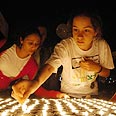
Remembering Rabin during national ceremony
צילום: ירון ברנר
Yom Kippur for Rabin
The time has come for personal and national soul searching
In Jewish tradition, Memorial Day is one of the names for Rosh Hashana.There is no concept of Memorial Day in Jewish tradition in the way it has been established by our modern-day State of Israel.
To deal with tortuous events and even, Jewish tradition created the fast day – both personal ones, for individuals in distress, and public ones, at times of crisis for the entire community.
This is the reason for four of the year's six public fast days: Tisha B'Av, the fast of Gedaliah, 10 Tevet and 17 Tammuz.
The difference between a memorial day as we know it, and a fast day is more than semantic. Whereas the main point of a memorial day- reliving the traumatic moment out of an inability to push it away, fast days deal with the future.
A difficult event brings us to a starting point, but not to the final destination. The main point of a fast is for us to search our souls to derive lessons of that painful event. This is soul searching has one main purpose – to push ourselves as far away as possible from the event, in order to ensure that such an occurrence does not, cannot, happen again.
There is no value in historical memory alone, but rather in taking steps that will force us to examine our ways.
Tough questions for Israeli society
Ten years after the Rabin assassination Israeli society must ask itself:
What should be the public face of the annual memorial day to Rabin? Should it be a memorial day, or perhaps it should be the principle of fasting?
A passing glance at Israeli society should be enough to realize the second option is the right choice.
As opposed to Memorial Day for IDF soldiers and Holocaust Memorial Day – days on which remembering is just about the only issue – Yitzhak Rabin Memorial Day must resemble Yom Kippur, or perhaps even more, Tisha B'Av: A day that it is impossible to separate from the painful past, but which has as a central theme the soul searching by people in the here-and-now, for his promise of a joint future.
A well-known Hassidic tale teaches that when a Jew beats his chest in repentance on Yom Kippur, he must take care to beat his own chest – not his neighbor's chest.
Too often, Israelis like to pretend they are the book keepers for the soul-searching of others. Too infrequently we point the finger at others.
In the ten years since Rabin was murdered, Israeli society has become expert in searching the souls of the other – to cover up and whitewash the personal and collective soul searching we have yet to do.
For the sins
And so, as we do on Yom Kippur, we must beat our chests and confess our sins.
For the sin of those who supported Rabin's political path, but failed to see the distress of the other camp, or its anxiety of watching the basic foundations of its faith crumble.
For our lack of ability to see through our tears of euphoria to notice the tears of pain and distress and fear of those who weren't part of the celebration.
For our dismissal and lack of caring about those tears.
For the sin of those who opposed Rabin's policies, who failed by allowing extremists and inciters to gain a foothold, until the "bad weed" overtook the entire flower bed.
For sages who were not careful with their words and poisoned their students, until their thoughts and the sounds of their consciences were corrupted.
For the fear and the evasion of soul searching. For the rabbis who pushed their disciples to the extremes, rather than to moderation.
And for the sin of each camp who ignored the writing on the wall, who preferred naïve, childish faith that "it can't happen here."
For the complacency and indolence, and for the fact we were unwilling to sound the warning bells before the fire broke out.
For the baseless hatred and the lack of attentiveness. For the sin of breaking all the rules of the game.
"For three transgressions of Israel, yea, for four I will not reverse it"
said the prophet Amos (Amos 2:6).
The writing on the wall is still there. All the candles, the ingenious posters calling for reconciliation, and the song sheets managed to cover it up for several years, but its still there, teasing us, challenging us: Have we failed yet again?
Yom Kippur for Rabin
On Yom Kippur we beat our chests while reciting a list of sins, set to the order of the Hebrew alphabet. Let us do the same for the little Yom Kippur, the one that entered into our lives ten years ago:
FOR THE SIN WE HAVE SINNED BEFORE YOU…for the sins of apathy, avoiding responsibility, haughtiness, for ignoring the writing on the wall.
For the sins of arguing for arguments sake, for belittling other people's opinions, for not listening, for being foolish, for arrogance, for getting angry, for scorning, for our civil war.
For the sins of not being vigilant, for forgiving those who cross our red lines, for laziness, for idle chatter instead of action, for over-righteousness, for dulling our senses, for being merciful to the cruel and the extreme, for baseless hatred.
For the sins we have committed against you by continuing to sleep. For all of these – forgive us, pardon us, atone for us.
Rabbi Gilad Kariv is an attorney and the associate director of the Reform movement's Israel Religious Action Center
