


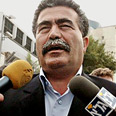
Peretz – Despite momentum, still far from premiership
צילום: רויטרס
Southern contest
Southerners Sharon, Peretz to face off in upcoming elections
Amir Peretz is on his way to a meeting with Clinton. He is wearing a metallic-blue shirt. The two upper buttons are open. He purposely gives up on a tie, and even a jacket. His car gets stuck in a Paris Square traffic jam, near the prime minister’s home in Jerusalem. He ditches the car and continues on foot. Cab drivers are honking at him, opening their windows, shouting words of encouragement. People approach him, shake his hand, and offer ideas. Peretz is thrilled. When he is called to Clinton’s suite he stays behind a little while longer to shake the hands of the drivers sitting in the hotel lobby corner. Clinton’s security guards can wait.
“You know what they say in Sderot about the race between me and Sharon,” Peretz asks, and replied immediately: “It’s the contest of the South”
Clinton greets Peretz warmly; His greatest talent is giving other people the feeling that he has dreamed of meeting them - and only them – his whole life.
Peretz, in fragmented but comprehensible English, asks to tell Clinton of his origins. I know, I’ve heard of you, Clinton says. The peace camp, Peretz says, has turned peace into an elitist concept. I will convince the people that peace is made for them; that it will improve their situation; that it works for everyone. I will capture the hearts.
Clinton was curious about Peretz’s plans on the economic front. I want to raise the minimum wage, Peretz said. They’re attacking me. When I was president I raised the minimum wage in America, said Clinton. Growth followed. Peretz was glad to hear it. From now one he can say the idea to raise the minimum wage came from Clinton, not Stalin.
For the time being, people are finding it difficult to formulate an opinion on Peretz. He’s been here for years, in the thick of things, and still, it appears he came out of nowhere. Just like the seasonal winner of Star Search. With nothing else to pounce on, people are turning their attention to the moustache.
First of all, he’s a skilled politician, pragmatic, and witty. Netanyahu, who clashed with him on several occasions during his tenure as finance minister, praised this week Peretz’s negotiations skills. He knows in advance what he wants, Netanyahu said (and quickly added: I beat him.)
Sharon associates present at the meeting between the prime minister and Peretz Thursday said Peretz appeared to come to the session well-prepared. The meeting lasted for only 25 minutes, but Peretz said everything he wanted to say. He didn’t interrupt, didn’t argue, and didn’t flatter. He displayed self-control, a trait Sharon highly appreciates.
“I’m telling you this affectionately,” Sharon said, “you’re acting irresponsibly. Look what happened to Fuad (former Labor party leader Binyamin Ben Eliezer,) who toppled the previous government. We could have done things together and part ways at the end of the term.”
“So let’s decide we don’t need elections at all,” Peretz said. “We’ll postpone elections to 2010. Look what’s happening in the meantime. You’re forced to bend national interests in the face of any pressure group. You have a faction that is largely against you. We’re entering an elections year regardless, so why drag it out. Let’s do it as soon as possible. It will be better for the country and for you, too.”
Eventually they will likely agree on a date in the beginning of March. This means a four-month election campaign – a relatively long time, perhaps too long. Sharon has enough time to ponder whether to run at the head of Likud or as the head of an independent party. On Thursday, he convened the so-called “Ranch Forum” – a group of close associates, officials, and public relations experts - at his Tel Aviv office. The decision wasn’t supposed to be taken there. On Saturday, when the real Ranch Forum will convene at his ranch – him and his sons, advertising executive Reuven Adler, and perhaps one or two more people – it is still doubtful he will rush to make a decision. He still has time.
Quitting without thinking
Will Sharon quit and form his own party or refrain from doing so? This is one of the most fascinating questions in the annals of Israeli politics. As things stand now, Sharon is expected to win the Likud primaries in the first round. A Sharon-headed Likud would win 30 to 40 Knesset seats and will be asked to form the next government.
Sharon’s indecision focuses on the day after. Sharon is concerned that as head of Likud he would not be able to form a government. He wouldn’t want to join forces with radical right-wing parties; they will paralyze any diplomatic initiative, even a minor one, even a fruitless one. It’s doubtful whether even the Right would want him. Going with Shinui or with Shas won’t be enough. The Labor party, the natural partner, is different with Peretz at its helm.
And most importantly, Sharon does not know how many “rebels” opposed to him would make it into Likud’s Knesset faction and how far they would go. A situation can certain emerge where Sharon leads the Likud into elections, but after them, when he has difficulties forming a government, enough right-wing Knesset members would prefer Netanyahu over him. After the meeting with Sharon Thursday I asked Amir Peretz whether he was impressed that Sharon is heading to a new independent party.
“He’s in a mood that favors leaving (Likud,)” Peretz said. “He hates his party. But his head is telling him to stay.”
Pavilion 28
Peretz’s aggressive behavior the day after his Labor primaries win was proven as the right thing to do. The Labor party ministers’ rebellion ended before it even started. Within a minute, everyone was talking as if their heart’s desire was always to move into the opposition. Everyone, except for Peres. He was insulted that he wasn’t offered a guaranteed spot in the next Knesset. Not that he would have trouble getting elected. Peres will overcome this hurdle. But Peres doesn’t like to ask to be elected. He wants to be asked, to be begged, to be forced to accept Labor’s decision.
Peretz proved that leadership is not given, but rather, must be taken. On Sunday, when he delivers his big speech at the Labor party’s central committee, the entire party will applaud.
The problem waiting in the wings is not his style, but rather, substance. Three parties at least, and possibly four, will attempt to portray him during the elections campaign as a radical leftist on the diplomatic front, as an anachronistic Bolshevik when it comes to socioeconomic issues, and as someone who isn’t ready to lead a country like Israel, which is still fighting for its life.
To judge by the polls, it’s doubtful whether this political brawl is even relevant. At the height of his victory celebration, surrounded by sympathy, Peretz is able to push Labor to 28 Knesset seats (up from its current 21.) This is very nice for a party that only a week ago was considered half-dead. It will give him some productive years as leader of the opposition. In order to be prime minister, he needs another 10 Knesset seats at least.
But during elections nobody admits to be running to the post of opposition leader. Peretz will be scrutinized as a candidate for the premiership. The argument would be that he’s threatening economic stability, and by doing so pushes away middle class voters. The second argument would be that he would concede plenty to the Arabs, thus distancing the political Center from his party. This argument worked against Peres in 1996, against Barak in 2001, and against former Labor party leader Amram Mitzna in 2003. It could work even more effectively against Peretz.
Peretz is trying to fight back. This week he initiated a meeting with leading industrialists, in coordination with Shraga Brosh, who heads the Industrialists’ Union. It will be a reconciliatory meeting, he says. He turned to the industrialists on purpose, not to the stock market sharks. He feels more comfortable with the industrialists.
The question isn’t only what he’s offering to give, but rather, where he’s planning to take it from. People are scared of increasing the government deficit, which would lead to higher interest rates and higher inflation. Peretz must promise them both a revolution and stability. He is threading the thin line between expectations and anxieties.
The Zionist Left is accountable for no more than 20 Knesset seats, comprised of the Labor party’s leftist pole and Meretz. If Peretz goes for this line, he may win one or two Knesset seats at the expense of Meretz, maybe something from Arab voters, but he will lose voters to Shinui and to Sharon. What happened to Amram Mitzna will happen to him, too.
Peretz ascribes great importance to his credibility. He refuses to emasculate his worldview because of electoral considerations. This is admirable. But if he wishes to succeed or at least to survive for another term, he must win more than 20 Knesset seats. In an aggressive elections war he may be erased.
The term “credibility” means one thing in life and another in politics. On the eve of the last elections, Mitzna’s campaign headquarters discovered that when it comes to polls and focus groups, Sharon emerges as much more reliable than Mitzna. How could that be, they wondered. One can say many things about Mitzna, but there is no arguing about his honesty. He’s true to his word. More so when it comes to facing off against Sharon.
As it turned out, when voters talk about credibility, they mean the gap between intentions and implementation. Sharon will be able to do whatever it is he wants to do. That is why he is credible. Mitzna would not be able to do what he plans to do. Therefore he is not credible.
If Amir Peretz wants to maintain his credibility, he must present before voters achievable targets. He should not go far, but rather, play it safe. And that’s difficult.
On this matter Sharon likes to quote Pazit, a girl from a satirical radio show on Army Radio. One day, Pazit decided to run for student council, Sharon recounts. She promised that everyone who votes for her will get a pencil case and a pencil. She was elected. A day later, the kids came up to her and demanded their pencil case. “But I promised you this before the elections,” Pazit said, and didn’t give them a thing.
