


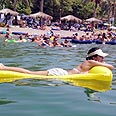
Relaxing at the Sea of Galilee
צילום: עמית מגל
Sea of Galilee: Cradle of Christianity
Most Israelis associate the Tiberias region with warm weather and view the city as a base for hikes in the Golan Heights and lower Galilee. But the area was also Jesus' home for many years, and is also full of Christian sites
We begin at Barniki Mountain, just south of Tiberias on the Tiberius-Zemach road.
Barniki was Agripas II’s sister, who buried a significant number of husbands, and was almost 40 when she became the 22 year old Titus’s lover. The signs leading to the mountain can be seen when driving south on the Tiberius-Zemach road.
The Barniki Mountain boasts an incredible view of the Sea of Galilee, Tiberius and its surroundings and the Golan Heights. One can also explore the ruins of the so-called “Anchor Church,” named for the half-ton anchor buried in its center. The ruins are impressive, but the preservation shows signs of neglect.
Continuing down to the Tiberius- Zemach road, we turn to the Yardenit baptism site for tourists created by the Sea of Galilee group. According to tradition, Jonathan the Cohen (Priest) who performed immersion rituals for Jews returning to the faith also used the Jordan River.
It is doubtful that this is the correct location, but as soon as faithful Christians from Germany, the Sudan or Brazil hear the words “the Jordan River” there is little hesitation when asked to give themselves to the cold water for purification of the soul.
Continuing north
Back through Tiberius and along the Sea of Galilee, just north of the city, to the right of route 90, is the YMCA Building. The central building was the private home of Dr. Harte, the late General Secretary of YMCA Jerusalem. The walls of the visitors hall are adorned with wood imported from Damascus in 1935, but the ceiling “disappeared” during the British Mandate period.
The church is modest and its main feature is a giant panoramic window overlooking the Sea of Galilee that creates a frame around the breathtaking view of the sea. The YMCA has a private beach, a few small pools and even guest rooms. There are no set opening hours here, you just knock on the door.
From the YMCA we turn north again, and then turn east towards Almagor and arrive at the Domus Galileae (House of Galilee) - a church, theology center and library of the Vatican. The building was completed about a year ago. Opening hours are 9:00 - 12:30 and 15:00 - 17:00.
Judgment day
The grey outer building doesn’t even hint at the beauty inside. When you enter, you discover a jewel of architecture that is designed like a Jewish yeshiva (rabbinical study hall), with beautiful stained glass windows that project colored lights into the building from the afternoon sun.
There is a very impressive large painting on the wall of the church depicting judgment day, the trial of good and evil and a struggle between an angel and the devil. On its left side there is a painting of the door leading into the Garden of Eden, and to the left of the painting is a statue of the burning bush and behind it is a small and distinctive prayer hall.
Next to the library two stone tablets dripping with water stand out, one in Hebrew and one in Latin. From the wide balcony is a special view of the Sea of Galilee with the slopes of the mountains that lead into it.
Maghar and Nin
The village of Maghar is in a constant state of tension due to the fighting between the different ethnic groups that live there - Christians, Druze and Muslims. Even the roof of the only church in the village was damaged during one of the incidents. This is the Greek-Catholic Church, simple but with its own individual charm.
The tour concludes in the village of Nin (opposite Dovrat, on route 65, between Afula and the Golani Junction). This is a Muslim village whose name is a twist on the word “Naim” - the Hebrew word for pleasant. The residents are from the Zoabi Clan that is spread out amongst seven villages in the Lower Galilee.
According to tradition, this village is the site of one of Jesus’ miracles: While visiting this village, he saw a funeral of a young child and brought him back to life.
The Franciscan Order bought land here in the in the 19th century and built a church that is maintained by the Muslim family that lives next door. The unknown church is simple and yet pretty. Inside there is a picture hanging on the wall of Jesus bringing the anonymous child back to life and behind the altar there are drawers with notes containing requests from pilgrims and visitors. There are no set opening hours; you just ask the family to open the church.
The Society for the Protection of Nature (SPNI) organizes tours to these hidden churches and Christian sites in the Galilee under the guidance of Assaf Dori, For more information: Teleteva - 03-6388688, Galilee Field School - 04-6620432, Assaf Dori - 052-2446494
