


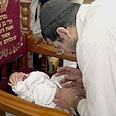
Circumcision. Hidden penis phenomenon?
צילום: לע"מ
'Penis will become normal over time'
A year-and-a-half after A's circumcision ceremony, his parents had to have their son re-circumcised under anesthesia after the first mohel 'didn't cut off enough.' The parents sued the first mohel, and won NIS 45,000 in damages
"A" was born in springtime. Eight days later, in keeping with one Jewish custom observed by nearly all Israelis, he was circumcised by mohel (ritual circumciser) Rabbi Shalom Ma'atuf.
But when the boy was two-and-a-half months old, his mother noticed his penis seemed uncircumcised. The frightened mother called Ma'atuf and asked him to examine the baby, but Ma'atuf never appeared. "Be patient, things will work out themselves over time," he told the mother.
At seven months, she called Ma'atuf again and expressed her concern. "Is the boy chubby?" asked Ma'atuf. The mother confirmed that was the case, and was told once again not to worry.
"Once he loses some of the 'baby fat' you will see his is circumcised. Eventually, your kid will be normal," assured Ma'atuf.
The scene repeated itself several more times, but Ma'atuf refused to examine the boy, maintaining that things would "work out."
Fears confirmed
When the boy was a year-and-a-half old, his mother finally took him to a urologist, who confirmed her worst fear: The boy was not circumcised properly, and his foreskin was almost completely intact.
Dr. Kessler then proceeded to circumcise the boy under full anesthesia.
The parents say the surgery put the family through a terrible ordeal.
"From a pleasant and smiley baby, our son became a frightened boy, often in pain, and constantly subject to anxiety attacks. We couldn't do anything about it," they told Justice Dalia Ganot of the Rishon Lezion Magistrates Court.
Conflicting opinions
Justice Ganot said the relevant issue was whether or not the boy required corrective surgery. This is where opinions differed.
Dr. Kessler, an expert witness for the plaintiffs, claimed that there was excess foreskin, a condition that can only be treated by surgery and not "over time."
But Dr. Atias, an expert witness for the mohel, disagreed. In his opinion, the boy suffered from "hidden penis phenomenon," a condition that would have corrected itself as the boy grew up.
Kessler said it was possible to determine that there was excess foreskin by pulling the skin back, towards the penis's shaft. But Atias claimed such an examination can only be done while the penis is erect, and therefore it was not possible to make that determination.
Heavy fine
After reviewing photographs of the boy's penis taken before the surgery, the judge awarded the boy NIS 45,000 in damages for emotional distress, and said the boy should be compensated for all future expenses - psychological therapy, increased diaper usage, medical treatments, etc.
"Even to the untrained eye, there is no doubt the penis was abnormal, and that it does seem uncircumcised (from the photos)," said Ganot. "Moreover, while Dr. Kessler is a surgeon specializing in child urology, Dr. Atias is a gynecologist that operates on women. What does a women's doctor know about penises?
History of circumcision
Circumcision is the second mitzvah of the Torah. It stems from the Book of Genesis, where Abraham is instructed by God to circumcise himself at the age of 99, his 13-year-old son Ishmael, and his newborn son Isaac, then just eight days old.
Although it is a surgical procedure, Jews have always relied on ritual circumcisers, called "mohels" in Hebrew, of whom only a handful are doctors.
Israel's Supreme Court has ruled that the procedure is considered a religious-ceremonial act, rather than a medical one, thus opening the door to mohels who are not trained doctors to perform the procedure. Nonetheless, the mohel must act with caution, and can be liable for compensatory damages, should he be found negligent.
Most Israelis circumcise
"We live in a Jewish state, where the majority of citizens – both Jews and Muslims – circumcise their sons. Had the boy grown up with a penis that seemed uncircumcised, he would have been considerably different from his friends. There is no telling what psychological impact that would have on his character and personality."
The author is a lawyer who specializes in insurance claims
