


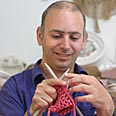
Enjoying knitting
Creating equal opportunity
Dikla’s complex Macrame acute hangs in private homes and public institutions, Eldad's knitting is sold throughout the country, and the kippot that Hagit designs get nothing but compliments. All three work in a center for people with special needs operated by the Yahdav (Togetherness) organization in Be’er Sheva
Eldad Cohen creates a variety of artworks from ceramic and wood, but he says he “always dreamed" of knitting.
“Within a month I taught myself how to knit and today my work is sold all over Israel.”
Hagit Yedid-Halevi is also a knitting and sewing expert. Her work includes embellished tablecloths, pillows, challah covers, kippot, and more.
"I like knitting kippot the best”, she says. “I devote most of my time to designing patterns and letterings for kippot."
Each day Eldad and Hagit join their colleagues, all people with special needs, at the employment center operated by the Yahdav organization in Be’er Sheva. The organization employs people with retarded development and cognitive impairments, as well as with the emotionally disabled and people with physical disabilities.
Erez Taviv and Dilkla Etrog are also employed at the center. Taviv spends his mornings doing arts and crafts, then metamorphoses into an actor in the evenings and participates in productions staged by the Be’er Sheva community theater.
Etrog, who has cerebral palsy, specializes in creating large macramé pieces.
“Sometimes, work on a piece can take a month or more”, she says proudly. Staff members proudly add that her works are widely acclaimed and can be found hanging in many private homes as well as public institutions.
Thousands of participants
Yahdav was founded in 1999 in an attempt to expand and improve the range of services and opportunities available in the south of the country. Now, seven years later, the NGO can claim development and implementation of more than 60 projects in which over 3,500 adults, youth and children - all residents of the Negev - take part, along with over 350 volunteers.
“Our wide-ranging perspective has led us to strive to create a continuum of services for the disabled, for the physically challenged, for children and youth-at-risk," say group leaders.
"Residents of the south have to cope with a great many challenges, including distances between settlements and from urban centers, a lack services, large numbers of new immigrants and high unemployment. A large percentage of the population requires support from social services. Together with other community activists and institutions, we are trying to fill, if only by a bit, the void."
