


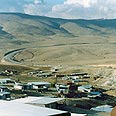
Unclassified Arab town in Negev area
צילום: סלוא עלינאת
Knesset: Another Arab city needed
Internal Affairs and Environment Committee also discusses unlawful construction, unclassified towns in Arab sector. Arab MK Dehamshe says ‘State does nothing to stop the illegal construction; it is too busy demolishing the houses, repeatedly’
The Internal Affairs and Environment Committee recommended Wednesday to build a new Arab city in Israel.
It’s too soon to know the location, not to mention the long process this recommendation will go through until it’s approved by the Knesset. But before any corner stone is laid, stressed the committee, there is much work to be done immediately and comprehensively to stop illegal construction in Arab towns, and the flourish of unclassified towns, a phenomenon indicating “contempt for the development and the law authorities.”
Committee consultant Adiv Daud, an architect and a city planner, presented the existing situation and recommendation for its improvement. The document he prepared reveals a severe problem in illegal construction in the big four districts: North, Haifa, Central, and South, where altogether one million fifty thousand Arabs reside.
The irregularities are: Building on land undesignated for construction, absence of permits, and construction on private land in spite of planning.
Committee chairman, MK Raleb Majadele, explained that the Arab citizen is not interested in illegal construction, but resorts to it, since the State - by delaying permits – makes legal construction impossible. “We need to freeze all illegal construction for a year, during which those legal permits and proceedings will be set. We need to bring change into the existing construction patterns in the Arab sector,” he said.
‘Arab public should increase cooperation with mayors’
MK Dehamshe said, “The State does nothing to stop the illegal construction; it is too busy demolishing the houses, repeatedly”.
In the north district – where 80 Arab towns dwell – the situation is better compare to other districts. In Haifa (25 towns), the report says, “We’re witnessing a lot of illegal construction, especially in Wady Ara, and Haifa. This points to lack of planning and contempt for the development and the law authorities.”
In the Central district (seven Arab towns) there is hardly any problem of unclassified towns, however the Southern district has 38 such towns. In most cases the existence of such towns contradicts state and county development outlines. “We’re witnessing lack of government policy, clearly and persistently. There is nearly no dialog between the citizens and the government,” according to the report.
Shamai Assif, director of planning in the Interior Ministry, said that the Arab public should increase cooperation with the mayors in order to stop the illegal building.
The committee also discussed and suggested a complete reform in the planning and construction law, budget allocation for city planning, and immediate development of government owned sites.
