


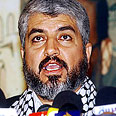
Hamas politburo Khaled Mashaal
צילום: איי פי
Hamas heads to Moscow in bid for legitimacy
Organization embarks on quest for international legitimacy on Friday with official visit to Russia, marking Islamic terror group's first talks with major power involved in Israeli-Palestinian peacemaking; Hamas spokesman says 'visit declaration of failure of pressures exerted by U.S. on world to besiege Hamas'
Hamas embarks on a quest for international legitimacy on Friday with an official visit to Russia, marking the Islamic terror group's first talks with a major power involved in Israeli-Palestinian peacemaking.
Although it deals a blow to U.S.-led efforts to isolate Hamas since it swept Palestinian elections in January, Russia's mediation is seen by some in the West as a chance to talk the faction into renouncing violence and recognizing Israel.
The United States said Russia must put pressure on Hamas to change its ideology.
"Our position is that if you are going to meet with a terrorist group, you should make it clear to them that their way of doing business is unacceptable, that their philosophy is contrary to the norms of the civilized world, and that they should get with the program," State Department deputy spokesman Adam Ereli said.
In Israel, the Russian overtures toward Hamas drew denunciations at first. But the Jewish state has adopted a wait-and-see attitude since Russia emphasized it was sticking to the view of international mediators.
Hamas regards the visit as a chance to push its position on the international stage.
"We will listen to the Russian government's vision on the Arab-Israeli conflict and we will clarify our own vision," Hamas spokesman Sami Abu Zuhri said on Thursday.
"The visit in itself is a declaration of the failure of pressures exerted by the United States on the world to besiege Hamas," he said. "Now Hamas is on the threshold of international legitimacy, thanks to the visit by Hamas leaders to Moscow."
Hamas, whose charter calls for the Jewish state's destruction, has masterminded 60 suicide bombings during a Palestinian revolt but has largely abided by a truce declared last year that paved the way for Israel's withdrawal from Gaza.
While so far ruling out permanent coexistence, Hamas has said it could accept a long-term cease-fire if Israel also quits all of the occupied West Bank and accepts an influx of Palestinian war refugees—both nonstarters for Israel.
'He completely adheres to these conditions'
Russia, among the quartet of mediators for a "Road map" to peaceful Palestinian statehood, is expected to tell a Hamas delegation led by exiled politburo chief Khaled Mashaal it must seek peace with Israel to win worldwide acceptance.
Acting Israeli Prime Minister Ehud Olmert told reporters in Jerusalem that Russian President Vladimir Putin had assured him that "He completely adheres to these ... Conditions and this is what he will present to the Hamas delegation when they arrive."
An Israeli official said his government was encouraged by reports Putin would not lead talks with Hamas. Russian Foreign Minister Sergei Lavrov is expected to head Moscow's delegation.
"The international consensus that they (Hamas) are not a legitimate partner for dialogue is still substantively holding, because they are not getting the level (of meeting) that they want," the official said on condition of anonymity.
Asked whether the White House saw anything positive in the Hamas visit, a senior Bush administration official said in Washington: "We would have preferred that no member of the quartet meet with Hamas until Hamas met the conditions set forth by the quartet.
"The Russians have told us that they plan to use this meeting to deliver exactly that message, and they think that coming from them strongly face to face, it can have real impact. Obviously if the meeting is going to take place, we hope they do give that message and we hope it does have an impact."
By inviting Hamas to Moscow, Putin is seen as trying to boost Russia's diplomatic clout in the Middle East, which has been on the wane since the disintegration of the Soviet Union.
Russia has also been key to efforts to defuse the crisis over Iran's nuclear program, by proposing that Iranian uranium enrichment—a process that can produce bombs—takes place on its soil.
"Everyone seems happy about Russia doing the job no one else dares to," said Sergei Kazennov, an analyst for Russia's Institute of World Economy and International Relations.
