


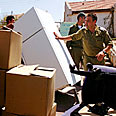
Homesh evacuation
צילום: יעל בר הלל, דובר צה"ל
Evacuees' visit to settlement called off
Families from evacuated West Bank settlement of Homesh were set to be escorted by army to visit remains of their former homes; however, army cancels tour following Ynet report
On Friday, eight months after they were evacuated from the West Bank settlement of Homesh, 15 families were set to visit what has left of their homes, in a visit coordinated with the IDF. Even though the visit was approved by senior Central Command officers, the army abruptly canceled the visit two hours after it was reported by Ynet.
Most of the families evacuated from Homesh moved to Yad Chana and most of them never went back to the settlement. Shortly after the evacuation, a few families who felt the need to see what happened to their homes visited Homesh, but for most of the families it was hard to go back to the place, and some families are still emotionally pondering whether to visit
Eti Rosenblatt, who used to live in Homesh with her husband, told Ynet: "Back in September we had the opportunity to go back and see what was left of Homesh, but I couldn't. I wasn't emotionally ready for it. This time it's important for me to make the tour."
The settlement of Homesh had both religious and secular residents, and during the pre-evacuation period the there was a lot of tension among the settlers as to how to define their struggle. The religious residents thought that the struggle should to be uncompromising, while the secular residents supported a passive struggle.
Homesh used to house 38 families, 24 of them secular, when they moved to Yad Chana. Some15 families were set to participate in Friday's tour.
'When are we going back home?'
Recently, the former residents decided they wanted to visit Homesh, even for one hour. They turned to the IDF and asked for a security escort, and the army complied.
Reuven Tabib, chairman of the former Homesh secretariat, was hoping the tour would also be attended by children.
"In one of the families there is a child who keeps on asking his mother, 'when are we going back home?'" Tabiob said.
Eti Rosenblatt said that the tour was meant be a closure.
"I was told that my grapevines were kept untouched, and if that's true I would like to take some of them and plant them in my new home in Yad Chana," she said.
