


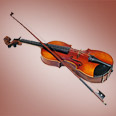
Violin: at the heart of Yiddish music
צילום: סי די בנק
France dances to Yiddish folk music
Paris exhibit celebrates Yiddish contribution to East European music
Paris’ House for Yiddish Culture is dancing to the tunes of Yiddish folklore with a new exhibition that looks at the history of Yiddish song through partitions, highlighting the central role of East European music.
Song is at the heart of Yiddish culture. It is a testimony of the Jewish communities’ story in Eastern Europe. The Jewish love of music is seen in the earliest biblical stories. People sing everywhere and anytime. Liturgical or secular, song accompanies the great moments and the daily life of everyone. Later, song became the favourite means of expression of the working classes, and of the Zionist, traditionalist and revolutionary movement.
Songs form an accurate reflection of Jewish life. Moreover, the Yiddish language enabled all of Jewish society to partake in the songs: intellectuals, students, women, children, the little tailor, the young bride, the rabbi, the patriarchs, and most importantly, the Yiddish mame.
Klezmer music expresses joy, despair, meditation, nostalgia, drunkenness, and, of course, love.
From the shtetl to Manhattan
Yiddish music is most commonly associated with klezmer, the Hebrew for “instruments of song.”
It was traditionally played on string instruments like fiddles and violas, the “tsimbl” (a Jewish instrument similar to a dulcimer) and flutes.
Klezmer music originated in the ghettos and “shtetls” or villages of Eastern Europe. The itinerant Jewish troubadours, known as “klezmorim”, performed at joyful events like weddings.
In New York, at the beginning of 20th century, people played, danced and sang in Yiddish. Yiddish musical theatre developed and was the forerunner of the Broadway musical. During this time, many songs and music were composed, such as “A brivele fun Rusland” by Solomon Smulevitz, and “A glezele lekhayim” by J.M. Rumshisky. Both are exhibited in The House for Yiddish Culture.
Other influences
Influences from Slav, Greek, Turkish, Arabic, gypsy music and later from American jazz transformed klezmer into a unique medley of sounds, which is easily recognisable and widely appreciated around the world.
Klezmer reached the United States in the mid-19th century, where figures like Dave Tarras, Naftule Brandwein and Abe Schwartz became famous musicians. Celebrated jazz musicians like Sidney Bechet and Benny Goodman also drew inspiration from the klezmer sounds which later also spread to Western Europe.
Vast collection
In 2005, the House for Yiddish Culture - Bibliotheque Medem received a large collection of 92 partitions of Yiddish songs released at the beginning of 20th century, mostly in United States . The less-known songs come from the Yiddish theatre in New York. This collection was added to the 312 partitions that were already preserved at the Bibliotheque Medem.
The House for Yiddish Culture works to preserve the Yiddish culture and make it accessible to a new generation. The centre offers a wide variety of Yiddish activities including language classes, lectures and workshops (Yiddish song workshops, theatre workshops, cookery courses).
The exhibition “La chanson yiddish a travers les partitions” runs until 15 September 2006 at the House for Yiddish Culture-Bibliotheque Medem. Passage Saint-Pierre Amelot 18, Paris. Tel. +33-1-4700-1400
Reprinted by permission from European Jewish Press
