


Olmert: No one is immune
Prime minister says Palestinian Authority, President Abbas responsible for kidnapped soldier's safety. Foreign Minster Livni convenes ambassadors to Israel, tells them: Next few hours critical, defense minister says there will be no forgiveness for those using soldier as tool
"I am sending a hug to the Shalit family, these are difficult moments that require remarkable patience and stamina," added Olmert.
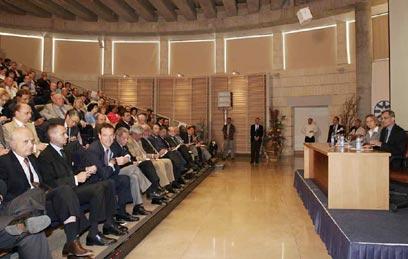
Livni in meeting with ambassadors (Photo: Haim Tzach)
The prime minister repeated his stance that the Palestinian Authority and its president iare responsible for the safety of the soldier.
Behind the scenes, a massive Israeli, Palestinian, and international effort is underway to track down the kidnapped soldier, Sergeant Gilad Shalit.
Foreign Minister Tzipi Livni told 60 ambassadors and foreign representatives that the "the next few hours are critical."
Livni asked the ambassadors to turn to their countries and exert pressure on the Palestinian Authority to release the kidnapped soldier. The ambassadors expressed their sympathy with Israel and some of them offered help in efforts to release the soldier.
France is also involved in talks to release the soldier, who also holds French citizenship, in addition to being an Israeli citizen.
French Ambassador to Israel Gerard Araud said today that in accordance with Israel's request, Paris began contacts with Abbas' Office. The ambassador is planning to visit the home of the Shalit family in Mitzpe Hila.
International pressure
"We want to promise the family that the French authorities have been recruited to bring about the release of its son, and that France is in contact with all of the possible and relevant sources," said the French ambassador.
In Paris, a similar statement was released by the French foreign ministry spokesman.
Egypt is playing a central role in contacts, and has sent a special delegation to Gaza. Qatar is applying pressure on Hamas' leadership abroad to find a solution to the crisis.
Ynet was told that senior Qatari figures spoke with Hamas' politburo head in Damascus, Khaled Mashaal, and with senior organization members in Damascus.
Meanwhile, the IDF is looking into the difficult questions centering around the attack on the outpost.

Major General (Res.) Giora Eiland, the former head of the National Security Council, has been appointed to head an investigation committee which will look into the attack and submit its conclusions to the defense minister and chief of staff.
IDF forces blew up the tunnel used by terrorists to penetrate Israeli territory, but also found that the tunnel branched out – pointing to possible plans to carry out a more complex attack.
Peretz: No forgiveness if soldier is hurt
Defense Minister Amir Peretz told a Labor faction meeting on Monday: "Bringing the soldier back home is a supreme value, there is no more important value. Every plan weighed is first and foremost viewed from the perspective of its consequences on the ability to release the solider. On the other hand, this is certainly a test for the deterrence power. It's true that the IDF doesn't have to prove its military supremacy every morning from now... but those who try to use a soldier as a tool or, God forbid harm him, should know that there will be no forgiveness and no penance for that."
"I am praying that we take the right decisions and we succeed in bringing our soldier home in peace," concluded Peretz, who said that diplomatic contacts "in the highest levels" are taking place, and that "heavy international pressure is being exerted on the Authority, so that it does everything to return the soldier." Peretz called on his political colleagues to unite behind the IDF: "Every statement that creates division during such a sensitive time is irresponsible," he said.
Ilan Marciano, Hanan Greenebrg and Ali Waked contributed to this report
