


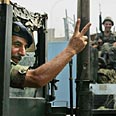
Lebanese army moves south
(VIDEO) Lebanese troops deploy in southern Lebanon, linking up with UN peacekeepers to take control of Hizbullah strongholds; Hizbullah fighters melt away as Lebanese troops cross Litani River, about 20 km from Israeli border. Dozens of people line roads, waving red and white Lebanese flags, throwing rice and flowers in celebration
Hizbullah fighters melted away as Lebanese troops crossed the Litani River, about 20 km (13 miles) from the Israeli border, security sources and Reuters witnesses said.
A UN-backed truce halted the fighting on Monday after the Security Council adopted a resolution calling for the Lebanese army and an expanded UN Force of up to 15,000 troops to deploy in the south and replace Hizbullah and Israeli forces.

More than 100 trucks, troop carriers and jeeps streamed across a makeshift bridge on the Litani to the mainly Christian town of Marjayoun, about 8 km from the Israeli border.
Some members of UNIFIL, the 2,000-strong UN peacekeeping force already in Lebanon, watched them cross.
Dozens of people lined roads, waving red and white Lebanese flags and throwing rice and flowers in celebration.
"May God protect you," 64-year-old Khadeeja Sheet yelled at the passing soldiers. "We support nobody except for our army."
The Israeli army said it had begun "transferring responsibility" In the south in a staged process that was "conditional on the reinforcement of UNIFIL and the ability of the Lebanese army to take effective control of the area."
Air blockade eases
A passenger flight landed at Beirut international airport for the first time in five weeks, easing an air blockade of Lebanon that Israel imposed throughout the war.
An airliner of Middle East Airlines, Lebanon's flag carrier, flew in from Jordan's capital Amman. A Royal Jordanian flight was due to follow. Scheduled flights are to resume next week.
An Israeli naval blockade remains in force, as part of an effort to stop Hizbullah from getting fresh arms supplies.
Israel also wants the Turkish military to impose an air and ground embargo to prevent Iran using Turkish territory to rearm Hizbullah, a senior Israeli security source said.
Israeli intelligence believes that nearly all of the heavy weapons that Iran has provided to Hizbullah passed through Turkish ground or airspace en route to Syria and then Hizbullah
fighters in Lebanon, security sources said.
Iran says it gives Hizbullah only moral support.
The UN resolution called for an arms embargo against Hizbullah, which fired nearly 4,000 rockets at northern Israel, but did not spell out how it would be enforced.
Two UN Envoys, Vijay Nambiar and Terje Roed-Larsen, were due in Lebanon and Israel to assess implementation of the truce.
