


Chirac: Lebanon force 'excessive'
France's Chirac says 15,000 troops for Lebanon UN force is too many; Germany's Merkel slams Syria
European and other nations have been dithering over how many troops to dispatch on the potentially hazardous mission, despite prompting from the United States, Israel and others.
Asked before talks with European foreign ministers whether he expected to be able to raise all the troops he is seeking, Annan replied: "Not today, but I will get the 15,000."
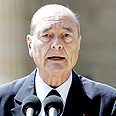
But French President Jacques Chirac, whose diplomats helped draft the Aug. 11 Security Council resolution that authorized up to 15,000 peacekeepers to deploy in Lebanon, said he was unsure how many troops were needed but that 15,000 was too many.
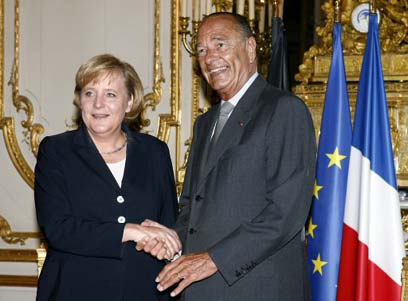
French President Jacques Chirac with German Chancellor Merkel (Photo: AFP)
The number was "completely excessive", Chirac told a news conference with German Chancellor Angela Merkel in Paris.
"It doesn't really make sense. So what is the right number, 4,000, 5,000 or 6,000? I don't know," he said.
Italy has offered up to 3,000 troops and France boosted its pledge to 2,000 on the eve of the Brussels meeting. Belgium pledged to take part in the force on Friday. Other possible troop contributors include Spain, Poland and Finland.
About 150 French soldiers arrived by ship in Lebanon's southern port of Naqoura on Friday to join 50 extra troops already sent as part of France's initial offer of 200.
European Union president Finland, which will chair the talks in Brussels, said the bloc's credibility was at stake and that it must show it can deploy rapidly to protect a fragile truce.
UN officials want a strong European contingent alongside a sizeable Muslim component in the expanded UNIFIL force, which is to work with 15,000 Lebanese troops being deployed in the south.
The UN-backed truce took effect on Aug. 14 after 34 days of fighting which cost the lives of nearly 1,200 people in Lebanon, mostly civilians, and 157 Israelis, mainly soldiers.
Merkel: Syria sending unconstructive signals
Israel wants the beefed-up UN Force to move to the border before it withdraws fully from Lebanon. It also has vowed to keep its partial sea and air blockade on Lebanon until the force deploys on the Syrian border to prevent Hizbullah from rearming.
Chirac said the blockade was "extremely prejudicial to the economy and life in Lebanon, and in my view quite unjustified".
Lebanon said on Thursday it would seek technical assistance from Germany to help control the border with Syria, but had no immediate plans to ask UNIFIL to deploy soldiers there.
Syria threatened a day earlier to close the border if UN troops were sent there.
"At the moment we are seeing some very unconstructive signals from Syria," Germany's Merkel said.
She said Syria was not helping to resolve the conflict between Israel and Hizbullah, but should in the long term be included in any political process to settle it.
EU countries had initially hesitated about sending troops into a danger zone between Israel and Hizbollah guerrillas. But say new rules of engagement for UNIFIL have reassured most.
