


The next prime minister
One would expect more honesty from someone who may become next PM
One of the topics discussed during the interview with Netanyahu focused on corruption in the public sector. The interviewer Gadi Blum mentioned that while Netanyahu served as prime minister he too was allegedly involved in financial irregularities with contractor Avner Amadi.
Allegedly, Amadi provided renovation and hauling services at the Netanyahu residence without ever submitting a bill. But after Netanyahu was ousted in the May general election the contractor reportedly sent a bill for USD 110,000 to the prime minister's government office, rather than to Netanyahu personally.
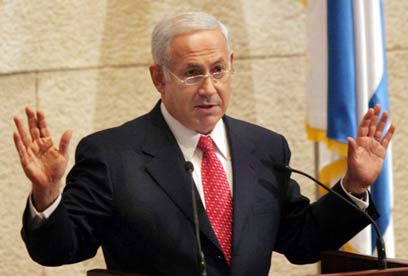
Netanyahu speaks (Photo: Dudi Vaaknin)
"Yes", replied Netanyahu, "but in my case it was one man's attempt to inflate his bill, which I refused to pay. That's all it was."
The reporter wrote: "The Netanyahu family still finds it difficult to digest the Amadi affair, which is viewed by Netanyahu and his wife Sarah as one of the most difficult times of their lives. According to them, they had lost an entire year of their lives due to this affair, until the attorney general closed the file and cleared them of any suspicion.
Wow, I said, this is news. It’s not exactly how I remember the affair. The Amadi affair was the subject of a series of investigative articles that appeared in Yedioth Ahronoth, the work of Mordechai Gilat. Former Attorney General Elyakim Rubinstein launched a probe into the affair and the conclusions were published on September 27th 2000.
"Deliberations were tough," wrote Rubinstein. "There was consensus among those handling the affair, because it is inappropriate to act in this manner in a government system (…) The Netanyahu couple didn't pay the debt out of their own pockets in the case of a private expenditure, nor did they settle it through the public coffers (…) the difficulty was in finding substantial evidence.
"This case warrants, even pertaining to non disputable evidence, harsh criticism. (…) those standing at the top of the pyramid and in its vicinity must be careful of slipping up, because even if such an act is not deemed a criminal offense, it is repugnant."
The closing of the file was not unequivocal due to other reasons: State Prosecutor Edna Arbel and her deputy concluded that there was enough evidence to put Netanyahu on trial. Rubinstein ruled the contrary.
As a mater of fact, even I thought then, and still do now, that the information disclosed by the press regarding the Amadi affair did not justify ousting a prime minister.
This is worth mentioning for two reasons only: One relates to the newspaper - a misleading impression has been created whereby it appears that the newspaper is denying the investigation it so proudly published in the past. The second relates to Netanyahu: If this is how he sums up his role in this sad case, it is very unfortunate.
One would expect a little more honesty, remorse and less sugar-coating from someone who may become the next prime minister.
Doubting accuracy of Bibi's other statements
This made me cast doubt on the accuracy of Netanyahu's other statements. He says among other things that the cutting of child allowances worked wonders: There was indeed a drastic drop in childbirth among the Arab population, yet Orthodox Jews continued bearing children as usual.
"Cutting child allowances will halt demographic risks," announced Netanyahu. It is true that there is a gradual drop in childbirth in the Arab sector, but to say that it is due to funding emits a somewhat racist and superficial odor.
He says that when he lost the elections and retired from the Knesset he was forced to live on a pension of USD 1,000 and an additional NIS 2,000 his wife earned. He couldn't make ends meet. "What should we have done?" he asks. "Should I have asked my father for assistance at the age of 50?"
What is so irritating here is that while Netanyahu said he found it difficult to subsist on a net income of USD 1,500 a month, during his term as finance minister he fervently argued a family could subsist on a lot less.
Fortunately, Netanyahu found another source of income, he made it rich and purchased a house in Caesarea, and now the State is covering the costs of bodyguards at two of his residences – one in Jerusalem and one in Caesarea.
Throughout the entire interview I didn't come across a single word on this house and his expenses. The two last prime ministers have assets worth millions, how could this be, asked the interviewer.
Netanyahu, writes the reporter, looked at him determinedly and said quietly: "Apparently they are much more talented than I am."
