


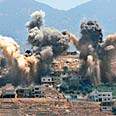
Lebanon bombing
צילום: איי פי
Independent: Israel used Uranium in Lebanon
British journal publishes opinion of gov't scientist stating two IDF bombing sites indicate elevated radiation signatures
According to a report in the British journal 'The Independent', Israel used bombs containing Uranium during its bombardment of Lebanon in the war this summer.
"We know that they drenched southern Lebanon with cluster bombs in the last 72 hours of the war, leaving tens of thousands of bomblets which are still killing Lebanese civilians every week," read the article.
"And we now know - after it first categorically denied using such munitions - that the Israeli army also used phosphorous bombs, weapons which are supposed to be restricted under the third protocol of the Geneva Conventions, which neither Israel nor the United States have signed," it continued.
Dr. Chris Busby, the British Scientific Secretary of the European Committee on Radiation Risk, said that two soil samples thrown up by Israeli guided bombs showed "elevated radiation signatures".
He states that laboratory tests of soil gathered from at least two bomb craters in Khiam and At-Tiri, suggest the use of bombs containing Uranium
Dr Busby's initial report states that there are two possible reasons for the contamination. "The first is that the weapon was some novel small experimental nuclear fission device or other experimental weapon (eg, a thermobaric weapon) based on the high temperature of a uranium oxidation flash."
"The second is that the weapon was a bunker-busting conventional uranium penetrator weapon employing enriched uranium rather than depleted uranium." A photograph of the explosion of the first bomb shows large clouds of black smoke that might result from burning uranium.
"When a uranium penetrator hits a hard target, the particles of the explosion are very long-lived in the environment…They spread over long distances. They can be inhaled into the lungs. The military really seem to believe that this stuff is not as dangerous as it is," Dr. Busby said.
The IDF said that the claim was being investigated.
