


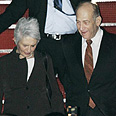
Olmert in US: Barghouti's release not on agenda
Talking to reporters during flight to Washington, prime minister makes it clear senior Fatah member will not be freed as part of negotiations for release of kidnapped soldier Gilad Shalit. Referring to Democrats' takeover of Congress, he says 'attitude toward Israel won't change'
On Sunday evening, Olmert is expected to dine with US Secretary of State Condoleezza Rice as a preparation meeting, and on Tuesday he will leave for the 75th annual United Jewish Communities (UJC) General Assembly in Los Angeles.
Ministers Tzipi Livni, Abraham Hirchson, Yuli Tamir and Isaac Herzog and Opposition Chairman Benjamin Netanyahu will also take part in the UJC assembly.
Talking to reporters on his way to Washington and referring to the negotiations for the release of kidnapped soldier Gilad Shalit, Olmert made it clear that the release of Fatah Secretary General Marwan Barghouti was not on the agenda.
He refused to address the talks held on the issue.
The prime minister also referred to the change of government system, saying that "we will invite both the Labor Party and the Likud to discuss it."
"What was presented at the Kadima rally was not the final version, but a version which will be formed in stages. This is the basis for negotiations between the opposition and coalition," he added.
Olmert is expected to find a different Washington than the one he knew in his previous visits: The Democratic Party completed its sweep of the two houses of Congress, and in the next two years the American presidents is expected to struggle in order to realize his policy.
Bush has already bid farewell to Secretary of Defense Donald Rumsfeld, architects of the war in Iraq, and has called James Baker and other conservative advisors who used to work with his father and at the time confronted the Shamir government.
Referring to the Democratic takeover of Congress, Olmert said it was still too early to assess how the elections would influence the moves in Iraq. He noted, however, the he believes the American stance toward Israel would not change.
No joint press conference
As a first possible hint to the disputes which may take place during the visit, and following the difficult incident in Beit Hanoun, White House officials announced that this time there will be no joint press conference following the leaders' meeting.
Before taking off to Washington, Olmert gave interviews to two of the United States' important newspapers, the Washington Post and Newsweek. He was asked what news was he brining the American president after the realignment plan, which he presented to Bush during his last visit and for which he was called "a courageous leader" was buried.
According to the prime minister, the recent war in Lebanon and the current situation in the Palestinian Authority did cause him to rethink the situation, but added he did not have plans to bury the desire for stable peace between Israel and the Palestinians, based on a two-state solution.
Olmert also referred to the Iranian threat during the interview, as one of the main issues to be discussed during his meetings in the American capital. He said that Iran must "start fearing."
These remarks, as well as comments directed at Tehran by Deputy Defense Minister Ephraim Sneh, have already been answered by the Islamic Republic, which said if Israel would attack, Iran's response would be "destructive" and "within seconds."
