


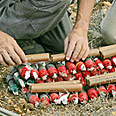
Gunners: We fired cluster bombs according to orders
Decision to appoint officer to probe use of cluster bombs during war in Lebanon irks IDF gunners
Officers in the IDF's artillery units don't understand why Chief of Staff Lit.-Gen. Dan Halutz has appointed Maj.-Gen. Girshon Hacohen to investigate the use of cluster bombs in Lebanon last summer.
According to testimonies of artillery officers, units that fired cluster bombs into Lebanon received approval from a representative of the army's land forces command.
"To my and my friend's surprise, we found ourselves at the center of the storm, when three months after the war the chief of staff decided to appoint an investigation committee to check if and why an improper use was made of the weapons systems my battalion is in charge of," on officer said.
"At the beginning I thought it was a joke. We were among the first reserve units to be recruited … Is it possible that the chief of staff, not to say his superiors, are unaware of the nature of my unit's operations? If these are banned weapons then why were we recruited and positioned in that section," he said.
'We followed the rules'
Ynet has learnt that in the early days of the war, 1,200 cluster bombs were fired into Lebanon, each containing hundreds of cluster bombs. Another 1,200 bombs were fired into Lebanon in the closing stages of the war.Orders were given to halt the fire after suspicions that a helicopter crash was caused by a cluster bomb.
Another officer said soldiers were given orders to limit the fire to 400 and 600 meters from Lebanese buildings. "This instruction was changed many times and the 'safety' ranges were expanded and shrunk for no reason … We had special tools which included aerial photos of every area to which we fired. The air force was updated on the fire."
All the firing was carried out in accordance with orders and safety ranges.
More so, it seems that areas lying north of the Litani River were placed under the direct control of the General Staff, which means that the Northern Command was not responsible for these areas.
At least ten Lebanese civilians were injured by unexploded cluster bombs after the fighting stopped.
