



Sderot mayor: Qassams returned us to reality
Eli Moyal says siren heard in southern town Monday afternoon confused public, as residents hoped fire would stop. Mayor stresses Sderot will continue as if there is no ceasefire 'until a significant period of time passes and we see diplomatic processes taking shape'
Residents of the southern town of Sderot, who expressed their doubts Sunday over the ceasefire, allowed themselves to try and return to routine on Monday, but the Color Red alert system caught many of them off guard, outside their homes and secured room.
The two Qassam rockets which were fired from the northern Gaza Strip landed in open areas, but residents know that only luck prevented a disaster and injuries, while the streets were filled with people again.
This was the second time rockets were fired at Israel since the ceasefire went into force, and Sderot residents understand now that they still have to remain alert.
Sderot Mayor Eli Moyal told Ynet Monday afternoon that he was not surprised by the rocket fire.
"We enjoyed 26 and a half hours of calm, but we did not act as if the Qassams ended," he said.
"This fire extremely confused the public because nonetheless, people were hopeful that it would stop. In one moment, the fire today returned us to the reality which is so familiar and something was undermined inside of us.
"We shall continue with our routine until a significant period of time passes and we see diplomatic processes taking shape," he stated.
Residents of the city said Monday that after a long period of time, they did not wake up in the morning to the sounds of the Color Red alert system, and this made them feel safe, but not for long.
'We believed ceasefire would last'
The siren heard in the afternoon caused an even greater panic then in recent weeks.
"One gets used to good things fast," a resident said, but the great surprise over the violation of the ceasefire was replaced by a lot of anger, and there are those who are already talking about the need to go out to the streets and protest.
One of the residents, Odelia Peretz, told Ynet: "There was a siren, and after two minutes another siren, and then a far landing. We were in the field in Sderot, because finally everyone allowed themselves to leave their homes.
"We believed that the ceasefire would last. The children were hysterical. The streets were full; suddenly people were seen in the streets. And they there was real hysteria. The sound of the landing was vague."
The residents' presence was seen on the streets mainly in the morning hours, when dozens of owners of small businesses were demonstrating in protest of the damage caused to their businesses and the fact they were not compensated for the damages.
Elraz Azram, owner of the Tnuva'le restaurant, did not have much hope that his customers would return and fill the place up following the ceasefire.
"If the situation continues like this for another month, I will be left with no other choice but to close it down," he said. "We are on the edge as it is. What is holding us are the deliveries we do, otherwise we would have closed the place down a long time ago."
_wa.jpg)
Qassam landing site in Negev (Photo: Tsafrir Abayov)
During the day, a group of tourists from Jerusalem arrived at the restaurant in a bid to strengthen Sderot's residents, but the number of customers could have been counted on one hand.
"I know Sderot's residents, and I am also like them," Azram explained. "Even if there really was a ceasefire, people would wait a few days to see that it really is serious. This is exactly like what happened in the north when the katyushas stopped and people were still afraid of more fire. We hope that the situation here improves because our situation is very difficult."
Many in Sderot expressed their anger Monday over the fact that Prime Minister Ehud Olmert, who has been touring the south for the last two days, did not bother to visit Sderot, especially these days.
"Rahat is really much more important," members of the struggle committee in Sderot said cynically, in light of the prime minister's visit to the Bedouin town Sunday.
Mayor Moyal refused to criticize Olmert, and only said that "I assume the prime minister had his reasons why he didn’t arrive in Sderot."
Business owners: People have stopped shopping
On Monday morning, dozens of business owners demonstrated in Sderot in protest of the fact that their businesses were collapsing and most of them were forced to close them down without any compensation from the government.
Although the government decided on an aid package to Sderot and the area, the city's residents view the decision as insulting and claim that they are being discriminated against compared to the regional councils.
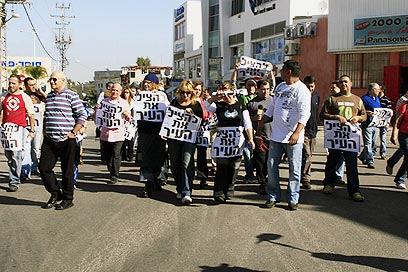
Bussiness owners protest in Sderot (Photo: Tsafrir Abayov)
According to sources in the municipality, the government approved compensation of NIS 17 million (about USD 3.95 million) for farmers in the Gaza vicnity "and not one valueless coin for the small businesses which are collapsing in Sderot. There is no sense in the ratio decided upon."
The municipality hopes that Defense Minister Amir Peretz would work to change the decision, which also a reduction in property tax. The Sderot Municipality also plans to file a petition regarding the issue to the High Court of Justice in the coming days.
Aharon Hugi, chairman of the committee for small businesses in Sderot, told Ynet: "We decided to run this struggle because we felt that no one is ready to help us. People have stopped shopping, people are in panic. The entire market area, which was hit by a large number of Qassams, is completely empty, and we expect to be helped like they helped the north, like they promised us in the past."
Attorney Omri Erez, who represents the business owners, said that he would approach the tax authorities, the government offices, the banks and the municipality with the business owners' claims.
"The situation here is catastrophic and we first of all expect to receive all the eases of restrictions and the benefits given to businesses in the north. There is a precedent and we will use it.
"They cannot discriminate. It's unthinkable that in the north they are fully compensated, while the Gaza vicinity residents don’t get a thing. We will sit with the business owners, listen to their problems and try and form some organized principles for action."
