


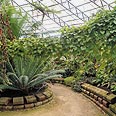
A garden at risk
Israel’s first botanical garden is fighting for its life at Hebrew University’s Mount Scopus campus
The Botanical Garden was established in 1931, by Professor Alexander Eig, together with Michael Zahary and Naomi Feinbrun, pioneers of botanical research in Israel. Eig envisioned a garden which encompasses the main flora of the Land of Israel. Each of the country’s regions is represented by a miniature habitat.
During the 19 years that Jerusalem was divided, Mount Scopus was located on the Jordanian side, and the Botanical Garden was neglected. Many of the plants did not survive, but a significant number of trees endured. University officials resumed their care of the garden following the Six Day War.
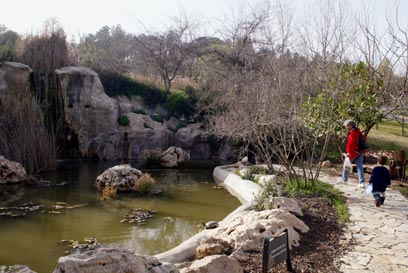
The garden (Photo: Amit Shabi)
Perhaps this is misleading. The word “care” conjures up images of orderly paths, verdant lawns, and esthetically pruned shrubs. However, none of these are to be found in the Botanical Garden.
Instead, the planners chose to let nature take its course. The result is unfettered charm.
Visitors can stroll through a Mediterranean grove reminiscent of the Carmel Mountains, wander around a humid thicket suggestive of Israel’s North, trudge over red loam, or walk on gravel. In addition, a tiny sand dune, comprising three wheelbarrows worth of sand, represents Israel’s sandy beaches.
Each plot is accompanied by a map indicating where the specific region in question is to be found. For example, a sign next to a patch of fruit-bearing sand-lilies explains that these flowers grow in the Negev. Moreover, the adjacent path consists of Negev sand, and a six and a half feet tall Mount Negev sits nearby.
Similarly, the Sinai is symbolized by a forsaken plot of red stones. A veritable Mini Israel.
Undoubtedly, the trees take pride of place. During autumn, the various deciduous trees paint the garden in shades of yellow, scarlet, and brown.
Note the reddish hue of the terebinth trees and the ornate fig and grape leaves. The olive trees yield small black fruit, and the sweet crimson fruit of the arbutus tree are currently soft and ripe.
Nicanor, Pinsker, and Ussishkin
Although there is more to see during the spring, even now visitors can observe flowering carob trees and early cyclamens. A planter next to the visitor’s center contains a blossoming Vartan’s iris as well as several specifies of crocuses, colchicums, and daffodils.
Six acres of burial chambers from the Second Temple period are situated in the garden’s center. Nicanor, the namesake of the Temple’s eastern gate, lies here, as do Leon Pinsker and Menachem Ussishkin, two leaders of the Hovevei Zion movement.
In the area dedicated to water plants, a pool represents marsh plants. Presumably, the pool is more attractive when covered by marsh irises and water lilies. Nevertheless, the autumnal leaves floating in the pools and connecting “streams” are an agreeable seasonal touch.
Don’t miss the fern plaza, which is surrounded by a high wall with dripping water. Exotic plants grow between the wall’s stones. Most visitors will appreciate the accompanying signs in order to identify the numerous plant species.
Eig’s terebinth trees are thriving this season. The red leaves crunch pleasantly underfoot as one descends towards the desert overlook.
At home, I checked out the crumpled page that I had received in the visitor’s center and noticed that I had missed the “rare and threatened” section. Unfortunately, there aren’t any pamphlets at the garden’s entrance. However, twice a month public tours are offered at no charge. I hope to avail myself of one of these tours in the spring.
For more information and reservations, please call 972-52-874-6424.
A forlorn garden
Recently, Botanical Garden employees received termination letters from the university, which intends to outsource the garden’s maintenance. In response, Mimi Ron, the garden’s administrator, recruited a group of botanists, scientists, nature-lovers, and conservationists to help save the garden.
Ron claims that a gardening approach - rather than a botanical approach - to the garden’s maintenance will undermine the progress made in recent years, during which time many new plant species were introduced to the garden.
As a result, Elchanan HaCohen, the university’s general manager, met with Ron and offered to freeze the dismissals. However, he requested that the university’s garden development plans continue apace.
“I am still worried,” Ron says, “that no one can protect the garden from the development initiatives, which are bound to chip away at the garden’s status as an active botanical garden.”
The university’s response: “The Hebrew University attaches great importance to the Garden’s continued maintenance, development and promotion, due to its historical and botanical value. Since the situation at the Botanical Gardens on Mount Scopus is not satisfactory, the University has decided to change its operational method.
"The University will appoint two academic advisors to supervise the Garden and will transfer its maintenance to a professional gardening firm. The University hopes that in the future, the Botanical Garden will attract the general public to this unique corner of nature.”
