


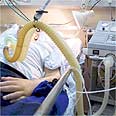
No more court petitions
צילום: סבסטיאן שיינר
New law: Terminally ill can refuse treatment
'Dying Patient Law' goes into effect Friday. Law allows terminally ill patients to refuse life-prolonging treatment
On Friday the "Dying Patient Law", which allows physicians not to administer treatment to terminally ill patients against their will, went into force.
The law defines a "dying patient" as one who is terminally ill and has no more than six months left to live, even with medical treatment, or as a patient suffering from a multiple system failure who has up to two weeks to live.
According to the law, regular medical treatment must not be suspended, but a doctor can refrain from providing medical treatment, or abstain from renewing a repeated treatment, without risking facing manslaughter charges.
Until today, terminally ill patients who wished not to receive life-prolonging treatment were forced to appeal to court.
The process of drafting and approving the new law has taken three years, and included numerous discussions at the Knesset's Health Committee, which authorized all its clauses.
According to the new law, the dying patient must explicitly express his wish that the treatment be withheld. If the patient is not competent, the doctors are to act in accordance with the instructions that were left by him, or follow the decisions of another individual who had been given power of attorney by the patient.
The patient's representative or guardian will have to declare that the patient does not wish to have his life prolonged.
The law stipulates that in certain cases, a professional committee at the hospital may be asked to determine in the matter, and that in case a difference of opinion arises, the decision will be handed over to a national committee.
Assisted dying prohibited
According to the law, even when a patient proclaims he does not want his life prolonged, the attending doctors are required to try and persuade him to receive oxygen or food. Physicians are also required to do the utmost to ease the patient's suffering, through the administration of pain killers or by offering psychological treatment.The law explicitly bans assisting suicide or taking any action which purpose is to end the patient's life, even when those actions are taken at the patient's request.
The law also refers to a situation in which a dying patient wants his life extended and asks for medical treatment. According to the law, the treatment must be given to him even if the attending physician believes that such a treatment is uncalled for.
Attorney Yitzhak Hoshen, who represented terminally ill patients in the past and a member of the committee that drafted the bill, defined the new law "a breakthrough."
"For the first time, The Knesset recognizes the individual's right to end his life, but not under any condition. The law does not meet the needs of cancer and AIDS patients, or those of patients in a vegetative state whose life expectancy cannot be evaluated," he stated.
