


Iran looks to re-examine relationship with IAEA
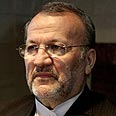
Iranian Foreign Minister Mottaki participates in closed parliament meeting addressing UN resolution's repercussions, bill calling on government to reconsider cooperation with IAEA proposed. Mottaki says government backs bill
Before the Parliament's open discussion, a private meeting was held behind closed doors with Iranian Foreign Minister Manouchehr Mottaki, in which the Security Council's resolution, and the pros and cons of the bill were discussed.
After the meeting Mottaki announced to the press that the Iranian government supports the bill. Iranian Parliament President Ghulam Ali Haddad Adel told Agence France-Presse that talks on the matter would recommence on Wednesday.
The bill proposal is worded in an unbinding manner, and calls on the government to "reconsider" cooperation with the IAEA – this wording gives the Iranian government a lot of freedom.
If the bill is approved, the government would be able to decide whether or not it would cooperate with the IAEA, and forbid the agency's inspectors to inspect Iran's nuclear facilities.
The bill is not committing, and only calls on 'reconsideration' of cooperation. Nonetheless, the Iranian government is not interested in worsening its relationship with the IAEA at the moment- as the agency's guideline is based on the fact that Iran has signed an accreditation that it would not distribute nuclear weapons, and has been obeying all the agency's rules and allowing inspectors to visit it's facilities.
Despite this, the Iranian Parliament wishes to show that it does not abide to the Security Council's decisions, and, internally, to show that it can influence the public agenda in Iran.
Centrifuge activity soon to be announced
One of the members of parliament present at the closed discussion, Ali Asgari said that Mottaki promised those present that an official announcement would be made soon regarding the usage of thousands of new uranium enriching centrifuges.
According to Asgari, Mattoki said that Iran has 3,000 centrifuges ready for use, and soon their activation would be announced.
Asgari said that "the main purpose of the Security Council's decision to place sanctions on Iran is a publicity war against Iran. The parliament members feel that if Iran backs down, their (the Security Council) demands of us will become harsher, and therefore we must insist and not give in."
The committee's members also demanded the government take all legal and diplomatic steps necessary to revoke the Security Council's resolution through international forums.
On Sunday morning Iran's Chief Nuclear Negotiator Ali Larijani announced that the activation of the 3,000 centrifuges at the uranium enriching nuclear facility in Natanz is Iran's response to the resolution.
Nonetheless, it seems his announcement was prepared in advance as a propaganda counter strike, and that the centrifuges have not yet been properly activated since the centrifuge activation has encountered some technical problems.
In order to enrich uranium for military purposes, thousands more centrifuges are needed, as is time and experience.
Petrol Minister: Will use oil as weapon if we necessary
Also following the Security Council's resolutions, Iran's Petroleum Minister Kazem Vaziri Hamaneh said Tuesday that Tehran has not ruled out the possibility of using Oil as a weapon.
In an interview to the Fars intelligence agency, the minister said that "If the need arises Iran will use any weapon necessary to defend itself."
Hamaneh added that the UN's resolution "will not have any effect" on Iran's conduct and its petroleum industry. He said that "Since even before the Security Council's resolution many countries boycotted us, the resolution's passing and implementation will not affect Iran significantly – and nothing new will happen. The contracts that have been signed still stand and no change will occur."
He continued to say that "It was a government decision not to give in to pressures, and this is our mission at the petroleum ministry, which is part of the government."
The minister even suggested his own solution to the problem of the sanctions – relying on Iranian companies instead of foreign companies. "We have attempted, and are still attempting to find alternative companies. In the matter of spare parts, we will settle with local companies."
