


From yeshiva to film school
He was studying in yeshiva, planning to be rabbi. Then he lit fire on Shabbat, ate lamb with cream sauce, and smoked joint. In his first book, Aviad Givon describes confusion of formerly religious
“I told them I'd smoked drugs in India,” says Givon, “and my parents took it badly. The thing is that among the national-religious crowd, even regular cigarettes are considered awful. I know someone whose parents know she’s become secular, but to this day she hides the fact that she smokes.”
What happened in your family?
“My parents wanted me to go with them to a man who counsels religious people in cases of drug use. I wasn’t willing to go, and then we spoke and I explained that I’m no longer religious. It was hard to talk to them after that.
I didn’t know if we could get past that and stay in touch. It took several weeks until we all realized that this was not something that should lead us to cut off contact, and we went back to being a family, even though to this day they still hope I’ll become religious again.”
Givon’s first book, The Picture is Looking at Me, was published recently by Ahuzat Bayit. Its heroine, a soldier from a religious home, describes the confusion of those who leave the world of religion. She spends her military service experiencing the secular world as she perceives it, having sex with anyone who even hints that he is interested.
Going wild
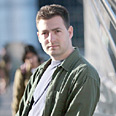
Today Givon’s life is not the way people thought it would be when he was a hesder yeshiva student. Having moved from Jerusalem to Tel Aviv, he is studying at the Sam Spiegel Film and Television School, and works as a programmer for a high tech company. Until he left religion he was the family’s great hope, and was thought to have what it takes to become a rabbi.
“In the army I was still very much in the mainstream of religious Zionism, of those who take the side of a greater Israel and the settlements in every discussion. I even left the yeshiva in order to go into a unit that was more into combat. It’s hard for me to put my finger on something and to say what exactly kicked me out. After the army I just realized that it no longer suited me, that religion was not for me.”
It’s usually a process.
“If there was such a process I wasn’t aware of it. I left religion two weeks after my discharge from the army, almost at the same time, and as the result of a personal decision. It began with my riding with two female friends on Shabbat into the desert and lighting a campfire. I lit the fire there.
"A week later I flew to India for work and I acted there like I was totally non-religious. We worked on Shabbat and ate lamb with cream sauce. It was jumping into the water head first. And the whole time I never stopped believing.”
In God?
“No, that I’m a sinner. For a long time I felt guilty about everything I did. When I was religious I knew that if I just did this thing and that thing, I'd be okay. As a secular person everything I do might be right and might not.
"When I ceased being religious I made myself a very strange rule that says that because I’m now allowed to touch girls I won’t touch a married woman. Even shaking hands. I realized that this was dumb, but I must have wanted to do this to preserve myself within the chaos. You are constantly looking for a different value system or at least a sign that will tell you that you’re okay.
“When I traveled to India I drove north to Manali. The whole way there I was surrounded by Indians only, I didn’t see a single backpacker and I began to weep because I felt so alone. I knew that there was a Chabad House in Manali and I thought I'd stay there for a Shabbat meal and kiddush. But on that day it was closed. I saw that as a sign, as if God were saying to me: ‘I don’t need you to return to me.’ It was a sort of like being reset.”
Givon’s confusion is typical of those who used to be religious and don’t really know how to deal with the new rules of the game. If there is one thing they’re sure of, it’s that they missed out on the years when their secular peers were having what they see as non-stop fun. To make up for what they missed - and many young women will testify to this - they allow themselves to go wild for a time without worrying about the consequences.
When I tell Givon my theory, he says that this period is a lot shorter than it looks. “Many secular people say that the formerly religious have sex to make up for all the years they were in yeshiva. I don’t think that this is connected to leaving religion as much as to the kinds of people who are seeking to jump into the next thing that they haven’t yet done.
"I also had a period like that which passed pretty quickly. At some point I felt that I was going a bit overboard with the sex thing. I suddenly caught myself with several women together in bed, and did I really want that? I don’t know if I wanted it. I said to myself, ‘Is this only because I wanted to break another record? To go somewhere I'd never been? Where will this actually end?’”
In the book you describe changing clothes in the bus on the way to going out on the town, and listening to music under a blanket, which is also a type of youthful rebellion. How does that rebellion manifest itself today, when you are no longer living with your parents?
“In the fact that it’s still hard for my parents to see me without a kippah, so I put it on when I go to their house. They know that I don’t wear it normally, but I don’t feel the need to hurt them in front of their face. And in general, if I come to my parents’ house it’s for the entire Shabbat because you can’t drive away in the middle and desecrate the Shabbat.”
