


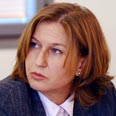
Deflating the Livni hype
Despite growing popularity, foreign minister's track record unimpressive
After the local idol went into deep sleep, with his replacement at the country's and Kadima's helm in need of being awakened just as badly, we've seen a new idol emerging around here: She's pure, clear, corruption-free, and appears to be the great white hope of many, particularly within her own party.
The party that promised to make life fun for us, but since being elected did everything possible so that almost everything around here will be painted black.
Yet Kadima isn't only about Olmert, Solodkin and Aflalo, it's also about Tzipi Livni. The foreign and justice minister and deputy prime minister at any party cannot be anything but an integral part of that party, regardless of its quality, and even if it's rotten.
When the party emanates a foul smell, the problem is not only related to the party head, but Livni's admirers think otherwise. In their eyes, once she raised her head, it was clear that a swan was born – clear, pure, white, and having nothing to do with her party's endless sins.
"She simply wasn't there." – Not when it came to government decisions, their implementation, or the failure to take required decisions. This is an absence of the most useful type: She's there for the good things but absent for the bad, and there we have a savior for Israel and an idol for the admirers.
The Olmert-Livni government declared in its basic lines that "the government would battle corruption at all the systems in the country, headed by the government and public administration system," yet less than a year after it took power these systems look as though they belong to a rotten banana republic. Still, the minister is claiming innocence and her supporters can continue carrying her on their shoulders.
This is apparently the combination that creates idols. The followers become blind, deaf, and anosmic; the media doesn't do its job; the idol avoids accountability, and idolatry continues to flourish.
Even if she is not to blame for even one of the misdeeds in her party's can of worms and continues to be perceived as honest, this is still an inadequate explanation for her rise in the ministerial ladder and the growing public support she enjoys.
When examining the path she took from the Regional Development Ministry to her current posts, it's difficult to identify even one event that can be seen as leaving a significant mark beyond the routine deeds of the ministries she was assigned to.
The most conspicuous of her ministerial deeds perhaps was at the Foreign Ministry during the war. As part of her job, the foreign minister was supposed to ceaselessly explain Israel's positions. Yet she almost never provided such explanations, and when she did, we could only regret it in retrospect and recognize the relative value of her silence.
What makes Livni a local Diva?
And then there's one example, among many others, regarding her judgment that goes back to 2004. During a live broadcast of a press conference in Washington, President Bush gave Prime Minister Sharon several vague pledges regarding the settlement blocs and return of Palestinian refugees.
Immigrant Absorption Minister Livni was sitting at the Channel 1 studio, and even before Bush finished talking, she already expressed her support for the disengagement, in a move reminiscent of the rashness of youth. Livni viewed the vague and unbinding presidential declaration as the epitome of everything she wanted, which of course allowed her to back the disengagement.
Yet Livni, as we know, also has some very decisive and consistent views. For example, on matters of relevancy. In February 2006 she ruled: "Mahmoud Abbas is irrelevant." Yet a few months passed and the irrelevant Palestinian president became the main anchor of the minister's policy, because "we must boost moderate elements in the Palestinian Authority."
Just like "minor clauses" in the Road Map peace plan, such as the dismantlement of terrorist infrastructures that used to be so important for the minister, are no longer relevant for her and "we can engage in negotiations under fire too."
And in her ideology-free party, according to Kadima member Meir Sheetrit, there must be plenty of values, and who's more worthy than Livni to be representing them. And so, Ms. Tzipora Livni was struck about a year ago by a moral epiphany.
"Controlling another people contradicts my values," said the minister who as we know ran for parliament several times as part of the Likud. This party didn't dream to adopt this kind of approach, just like the two-state vision, which recently has become the minister's unofficial trademark, has not been proudly displayed by Likud heads.
So what makes Livni a local diva after all? It is likely that what the public perceives as a leadership wilderness has much to do with it, beyond the fact she has not been involved in corruption. But perhaps the explanation can be found in the words of Lin Yutang, who claimed that "When small men cast long shadows, it is a sign that the sun is setting."
