


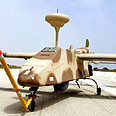
Air Force receives new UAVs
Israel Aerospace Industry to deliver new batch of hi-tech drones used in Lebanon over summer
The drones, called Mahad 2, are manufactured by the Israel Aerospace Industry (IAI), and have already served the Air Force, providing it with new reconnaissance capabilities during the Lebanon war over the summer they can remain in the air for an extended period of time.
Speaking to Ynetnews, Doron Suslik, Deputy Corporate Vice President for Communications at IAI, said that UAVs are playing an increasingly central role in Air Force operations.
"In Lebanon, UAVs were used on the border with Israel in order to bring back intelligence. They can send pictures back of enemy territory through a special communications channel. If the UAV falls for technical reasons, or enemy fire, it's not a big loss, as they have a self-destruct program. The price of flying a UAV is not like that of an F-15. The Air Force is basing more and more of its operational concepts on UAVs," Suslik said.
He added that the Mahad 2 UAV can operate at "any time, night or day, in all conditions, including heavy clouds, for anti-terror operations. Hostile activities can be photographed 24 hours a day, and beamed back to a command and control center, where commanders can monitor movements of vehicles in Lebanon."
The IAI was also working with the Israel Institute of Technology in Haifa to produce a new line of solar-powered drones, the 'Sunsailor,' described by Suslik as a "very interesting concept."
At a conference held last month in Tel Aviv, IAI also unveiled its participation in an international program to produce a new line of unmanned passenger aircraft.
Susklik said that recent developments in drone technology would have direct consequences on the next generation of passenger planes, predicting that "in 10 to 15 years, we can assume that planes will be flown without pilots. Passenger and cargo planes will fly from destination to destination without a human presence."
