


Hizbullah takes advantage of quiet
צילום: איי פי
'We're responsible for Hizbullah'
IDF officers say Israel's lack of response to northern border led to enemy's armament, last summer's war
The situation in southern Lebanon in recent years, during which the IDF often refrained from responding to Hizbullah activity, laid the groundwork for last summer's war, according to many officers from IDF's Northern Command.
The political and military decision-making processes following Israel's withdrawal from Lebanon in 2000 were examined thoroughly by the Winograd Commision. Tomorrow, the partial publication of the commission's report will expose the mistakes that led to the enemy's armament in the north.
"If you ask me," said a former officer from the Galilee Division, "we brought about our situation last summer. As we all saw, it wasn't a playground, but a battlefield.
When there's an enemy so close to the border – a real enemy who exposes his capabilities from time to time – if you ignore him in order to avoid opening a front against him, it's clear that one day everything will explode in your face, and this is exactly what happened."
IDF sources say that the political leadership paid little attention to the northern border in recent years. Decision-makers were barely involved in the northern arena unless there were pinpoint incidents that interested them briefly.

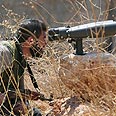
Hizbullah operatives on the border fence (Photo: Reuters)
According to senior officers from Northern Command, this was due to the intense involvement in dealing with terror activities emanating from Gaza and the West Bank.
"It's important to remember that the IDF's resources are limited," the officer explained. "The suicide bombings that plagued the nation occupied all of us. Not only did no one talk of the north, they were worried about opening a second front."
The numbers speak for themselves: Between 2001 and 2004, 108 suicide bombings left 502 Israelis dead. The IDF concentrated on foiling such attacks (184 in 2003 and 116 in 2204). Hizbullah used the resulting quiet on the northern border to arm itself.
"In such a situation, we can clearly see why everyone was occupied with central and southern Israel, and why the north didn't interest them," a military source explained. He said that even before the war, when northern commanders warned of possible kidnappings and dangerous levels of Hizbullah armament, hardly anything was done.
"The major problem is that this policy spread from the political leadership to IDF leadership, such that even during military meetings, the topic of the north hardly came up," he said.
A consistent policy
One can see the difference in the north before and after the war by looking at the IDF's deployment on the border, now all along the blue, with constant sweeps of the area."These things just didn't happen in the past, because it might have caused a conflict that we were trying to avoid," the source said.
Military sources who spoke up in recent years avoided using names of prime ministers, defense minister, or generals, but rather addressed the big picture. "The policy was the same policy, and it didn't matter if (Ariel) Sharon was prime minister or if Maj-Gen. Benjamin Gantz was Chief of Northern Command," one officer explained.
Nonetheless, IDF sources implied that the facts about Hizbullah and the northern border were well-known and publicized among military personnel and that it was the political leaders whose decisions made matters worse.
"Everyone always spoke of our interest in keeping the north as is, and not hurting tourism. Every time a military response was considered, it lost a war to tourism," said one source.
The military sources are convinced that had the IDF been more decisive along the border with Lebanon in recent years, even if it involved short-term operations, Israel would not have ended up in a war last summer.
