


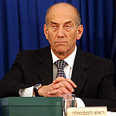
Olmert
צילום: גיל יוחנן
Let Olmert remain in office
Other premiership candidates may have shortcomings that are far greater than Olmert's
Amid all the media commotion one truth is being pushed aside: Just as full responsibility during the war rested on Olmert's shoulders, it does so now as well.
On President Truman's desk there was a sign that read "the buck stops here." Responsibility also stops at Olmert's desk. Namely, the fate of the nation in the near future will be influenced by what he decides to do, and therefore it is incumbent on him to seriously weigh his moves without taking personal considerations into account.
Whether he resigns or calls for new elections, the responsibility is his. It is not the responsibility of anyone like me typing away their two cents worth of wisdom on their computers. Neither is it the responsibility of the five-member Winograd Commission, despite their praiseworthy work in providing thorough criticism and in outlining the character of an ideal government.
Had the commission maintained that Olmert was not fit for the post due to some fixed fault in his personality or judgment, it would have been its responsibility to recommend his replacement post haste and the process by which it should be performed. As the commission did not do so, and assuming that it was aware of such a responsibility, the supreme responsibility lies on Olmert's desk.
It is reasonable to assume that Olmert understands that he is the only person who has the responsibility to decide what the better option is vis-Ã -vis is the possibility of another war in the summer. One option is to keep the cabinet going and to rectify errors as it goes along, or to place the country in a state of limbo from which another prime minister will emerge who may be less experienced than he is or less cautious than him.
It is doubtful whether he can be objective in his considerations. But nonetheless, it is his responsibility, not the responsibility of those who always know better in hindsight and who take no responsibility for their advice.
Half tea, half coffee
However, as he has not yet made a final decision, I will allow myself to make two suggestions.One: Recognize wholeheartedly the responsibility for the failures outlined by the Winograd Commission. It appears that the main failure was the sad combination of arrogance and hesitation. You set unreasonable targets but tried to achieve them cheaply by trial and error. This method does not work in war. It is permissible and even advisable to hesitate before embarking on war, but from the moment it has been launched its objectives must be sought despite the risk of casualties, and political limitations have to be stretched as far as possible.
Take Levy Eshkol for example. A joke about him tells how when asked whether he wanted tea or coffee he would answer "half and half." That's how he sounded on the eve of the Six-Day War. However, in the war itself the army achieved a glorious victory, primarily because he aimed for victory without making cost-benefit calculations and because the government didn't heed to the warnings from Paris and the discouraging messages from Washington. You, on the other hand, preferred half tea and half coffee.
Another piece of advice: All this can be rectified by awareness, unless we are talking about built-in character faults. I don't think this is the case here and other candidates may have shortcoming that are far more difficult to fix.
Therefore within your role of responsibility for the near future, you'd be better off if you remained in office, if they let you.
