


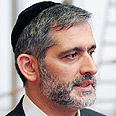
Minister Eli Yishay
צילום: ודים דניאל
Minister Yishai says supported war in solidarity
Shas chairman tells Winograd Commission he opposed extending IDF actions in Lebanon, blames enemy's success on failing Israeli spokesmanship. Commission also publishes Prof. Asa Kasher's testimony
The Winograd Commission probing the Second Lebanon War released on Thursday the testimony of Industry, Trade and Labor Minister Eli Yishai.
The commission also published the testimony of Prof. Asa Kasher, author of the IDF code of ethics.
Yishai, the chairman of Shas, was among the war's "council of seven," alongside Prime Minister Ehud Olmert, Defense Minister Amir Peretz, Foreign Minister Tzipi Livni, Vice Premier Shimon Peres, Transportation Minister Shaul Mofaz and Internal Security Minister Avi Dichter.
"The political and military achievements of the war were good," said Yishai in his testimony, "But I still think they could have been reached in the first few days of fighting, without a ground incursion.
"The general public's expectation, thinking the IDF was essentially an undefeatable army, made for some very high expectations," said Yishai. "I can say with absolute certainty: If the same goals were achieved in the first or second week of the war, we would have come up on top."
Winograd members Prof. Ruth Gavison and Maj.-Gen.(res.) Menahem Einan asked where, in Yishai's opinion, the blame lay the most – with the military itself or with high-ranking politicians, who didn't seem to ask the right questions.
"The prime minister was very clear about us not kidding ourselves, this was not going to be quick or easy," said Yishai.
When asked if there were any questions the military didn't answer he replied, "I'll tell you what I remember. I asked 'so what now?' We're in. This and this many are dead. Where do we go from here?'
"I was trying to stress that we didn't have to resort to a ground incursion. I said it than and I'll say it again: with our military might, even if we are war ready, even if - and I'll take things a little further – in two or three years we'll have full readiness and an unlimited budget, we still shouldn’t take on a guerilla army."
When asked why, if he so believed, he voted for the expansion of the military action in Lebanon, Yishai explained he did so in the name of solidarity, seeing how in his opinion, his vote would not have been the deciding one.
Yishay told the Winograd commission he was one of the biggest supporters of the establishment of a state commission of inquiry regarding the war, and the decisions leading up it.
"We should take a long, hard look at ourselves, and draw the appropriate conclusions," said Yishai. "The public outcry comes as no surprise to me. It is quite possible we didn't do enough to inform the public of our intention in time."
