


Harvest festival's foods
Phyllis Glazer ponders the meaning of the holiday and offers three dairy recipes that combine ancient and modern to create a sumptuous Shavuot meal
“He shall come home with shouts of joy, bringing his sheaves With him.” (Psalm 126:6)
Last weekend I detached my teenage daughters from their cellular phones and the internet, and packed them into the car to visit their paternal grandmother on Kibbutz Nir Am, just across from Sderot, the northern Negev town often the target of qassam missiles. Had I arrived just a few weeks earlier – mid-way between Passover and ShavuotI would have still been able to catch a glimpse of fields of green wheat. But now, less than a week before the harvest holiday of Shavuot, the stalks were golden brown and ripe for picking.
Harvest festival?
Growing up in America, Shavuot had always been "Z’man matan Torah" – the Time of the Giving of the Torah. And yet here before us was the Bible brought to life: “Israelites,” as the book of Exodus commands, “shall hold a festival for the Feast of the Harvest, of the first fruits of your work, of what you sow in the fields” (23:16).
So how did the spring agricultural harvest festival the Bible describes and the kibbutz celebrated, turn into what we knew as the “Time of the Giving of the Torah"? When the Temple stood, Shavuot, like Passover and Sukkot, was a joyous pilgrimage festival: thousands of farmers and their families traveled to Jerusalem to offer a basket of their first fruits to God. Then, acting on behalf of the whole nation, the high priest presented the offering unique to Shavuot on the altar: two loaves of bread, baked from the newly harvested wheat.
For having received “the rain, the seed, the sunshine,” from God, the Israelites reciprocated by offering the bread they had baked to God. But the fall of the Temple meant exile from the land. Refusing to imagine the festival dying, the rabbis of the Talmud infused it with new meaning. Searching through the Bible like determined detectives, they found clues that proved to them that the ancient harvest festival had actually coincided with a “spiritual harvest” too: what the Israelites “reaped” at Shavuot was the Torah. In the centuries that followed, it was the giving of the Torah that became the “partnership” between God and Israel to be celebrated at Shavuot.
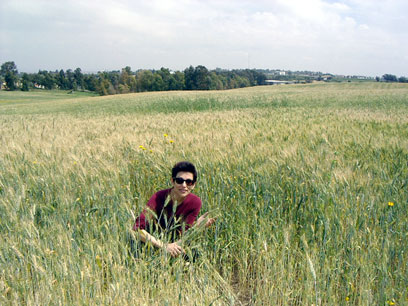
A Biblical touch - Phyllis in a field of wheat
Even though the wheat harvest was at the epicenter of festival celebration in ancient times, dairy foods have become the culinary heart of the holiday today. The explanations given are often fanciful, among them: in Hebrew numerology, the word for milk (halav) equals 40 – the same number of days that Moses lingered on Mount Sinai to receive the Law.
So when planning a Shavuot meal today, I like to blend both ancient and modern traditions, and keep in mind that the real meaning of the holiday includes fresh wheat and barley – the latter harvested just weeks before, tender young greens of spring, and touches of the “first fruits” of the season, primarily those representing the Seven Species.
These three recipes combine both grain and dairy in very special ways:
Hot and bubbling semolina nad sage gnocchi
Semolina is manufactured from coarse particles of wheat left after the finer flour has passed through a bolting machine, and is most often used for pasta or gnocchi. It is available in most supermarkets.
Of all the herbs that flourished in the spring in ancient times, sage was probably the
most valuable. Not only did it serve our ancestors as a culinary herb, they also chewed on the fresh leaves to promote fertility and longevity, and threw them on a red-hot fire to help keep illness - interpreted as the “Evil Eye” – away.
Serves 4-6
2 ½ cups milk
1 ½ teaspoons salt
⅛ Teaspoon nutmeg
1 ⅓ cups semolina
4 teaspoons minced fresh sage leaves
Freshly ground black pepper
2 eggs
1 cup (4 ounces) freshly grated Kashkeval, Parmesan or Pecorino cheese
5 tablespoons melted butter
A few small (1” or less) fresh sage leaves, to garnish
Butter a large baking sheet or pan (that will fit into your refrigerator) and set aside.
In a heavy-bottomed medium saucepan, bring the milk, salt, and nutmeg to a boil over medium heat. Add the semolina to the pot gradually, stirring constantly with a wooden spoon to avoid lumps.
Add the sage and a few grindings of pepper, lower heat slightly, and cook stirring constantly, until the semolina thickens. It is ready when the spoon will stand, unsupported, in the middle of the pan.
In a small bowl, beat the eggs with a wire whisk and add half the cheese. Beat into the semolina with the wooden spoon till incorporated.
Pour the mixture onto the prepared sheet, and smooth into an even ⅓” thick layer using a palette knife, dipped in hot water as necessary. Let cool at room temperature, cover with plastic wrap and chill in the refrigerator until firm, at least 1 hour.
Preheat the oven to 400F (200ºC). Butter a 9” oven-to-table baking dish.
Use a 1½” in diameter small glass or cookie cutter, dipped in hot water periodically, to cut out small circles of the semolina and transfer them to the dish. Work from the outside in, in a circular slightly overlapping pattern. Tuck in a few small fresh sage leaves here and there between the gnocchi, if desired, for garnish.
Brush the tops with the melted butter, and sprinkle with the remaining Parmesan cheese. Bake in the center of the oven for about 12-15 minutes or until crisp, golden and bubbling. To brown the top, slip under the grill for less than a minute, watching carefully to avoid burning the cheese. Serve right from the oven.
Whole wheatbery tabbouli with Biblical butter
With the scent of freshly harvested wheat as his inspiration, Israeli Chef Erez Komorovsky celebrates both the whole wheatberry and fresh greens of spring in a salad traditionally devoted to bulgur – Tabbouli. Instead of using just olive oil as we do in modern times, Erez adds clarified butter reminiscent of samneh - the clarified butter used in the days of the bible. Additional extra-virgin olive oil may be substituted if desired.
It’s best to rinse and soak wheatberries overnight to reduce cooking time, which depending on their age, can take anywhere from 1-2 hours. After cooking the wheatberries will never get as soft as rice, but they give the salad a pleasantly chewy taste.
NOTE: The wheatberries may be cooked, and the greens chopped, somewhat in advance, but this salad should be put together right before serving.
Serves 4-8
1 ½ cups whole wheatberries
1 cup finely chopped Italian parsley
1 cup finely chopped fresh mint leaves
1 cup finely chopped fresh basil leaves
1 cup finely chopped fresh dill
1 cup finely chopped cilantro
½ cup scallions (white and tender part of green), finely chopped
5-6 tablespoons freshly squeezed lemon juice
¼ cup extra-virgin olive oil
¼ cup wildflower honey
½ cup clarified butter
Salt
Coarsely ground white pepper to taste
Rinse and soak the wheatberries overnight, drain and place in a pot with water to cover. Bring to a boil and cook over medium-low heat for 1-2 hours, or until the wheatberries are tender but still slightly chewy. (Cooking time varies according to age of wheatberries). Drain and rinse under cold water to stop the cooking process.
Whisk lemon juice, olive oil, honey and clarified butter in a small bowl, season with salt and pepper and pour over the wheatberries. Mix in the parsley, mint, basil, dill, coriander and scallions with a fork. Let stand for 5 minutes, taste and adjust seasoning and serve immediately.
Mom’s famous buttermilk pie
This delightful alternative to cheesecake is so rich tasting; it’s hard to believe it is made with buttermilk. Serve warm or chilled.
For a 10” pie crust:
1 ½ cups unbleached all-purpose flour
½ cup cold butter
½ teaspoon salt
1 egg yolk blended with 2 tablespoons water
For the filling:
2 cups buttermilk
2 tablespoons melted butter
2 egg yolks, beaten
2 tablespoons flour
⅛ Teaspoon salt
½ cup sugar
3 egg whites
In a medium bowl, sift flour and salt. Cut in the cold butter with a pastry cutter or two knives (or your fingers if your mother isn’t looking), until coarse crumbs are formed. Mix in the egg yolk and water with a fork. Flour your hands and form a ball. Wrap in plastic wrap and chill for 1 hour.
Preheat the oven to 375°F (190ºC). In a large bowl using an electric mixer or a wire balloon whisk, blend the buttermilk, butter, egg yolks, flour, salt and sugar till smooth.
In a clean, dry bowl, beat the egg whites until soft peaks form, and fold into the buttermilk mixture with a rubber spatula until completely blended.
Roll out the piecrust on a lightly floured board till large enough to fit the bottom and sides of a 10” pie pan. Pierce it with a fork (or weight down with pie weights or beans placed on a circle of parchment paper), and bake 10 minutes. Remove from the oven and cool.
Increase oven temperature to 400°F (200ºC). Stir the buttermilk mixture again and pour into the prepared crust. Bake for 10 minutes, then lower heat to 350°F (180º) and bake for 25 minutes till firm and nicely browned in the center.
Phyllis Glazer is a freelance food writer with a regular blog on YNET in Hebrew. She is also the author of "The Essential Book of Jewish Festival Cooking" published by Harper-Collins, in which these recipes appear. Comments and culinary queries can be sent to [email protected]
