


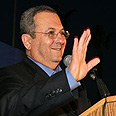
Ehud Barak. Redeeming image
צילום: עופר עמרם
'Arab support for Barak a disgrace'
Bad blood between former prime minister and Israeli Arabs, dating back to October 2000 riots, does not stop them from favoring him over Ami Ayalon in Monday's primaries. Minister Herzog: We are moving towards national reconciliation
Former Prime Minister Ehud Barak won the support of 33 percent of Labor's Arab members in Monday's first round of voting for the party's leadership, according to a breakdown of the final results.
Barak was only second to Defense Minister Amir Peretz who was the most popular Labor candidate among Arab party members with 34.4 percent.
Barak's popularity among Israel's Arab minority slid towards the end of his tenure as prime minister due to his government's handling of the October 2000 riots during which 13 Arab citizens and a Palestinian died in clashes with the police.
In the overall primary results, Barak came first with 35.6 percent of the votes, failing to surpass the 40 percent bar needed to claim the Labor leadership.
He will face former Shin Bet chief Ami Ayalon in the decisive second round on June 12. Ayalon garnered 30.6 percent of votes.
A surprise for many
Support for Barak among Arab party members came as a surprise for many, including some of his closest aides, and displeased the families of the October 2000 victims."That's treason, a disgrace… I suspect Barak will beat Ayalon in the second round thanks to the Araboushim," said Hassan Asala, a spokesperson for the families, using a derogatory Hebrew term for Arabs.
Asala made it clear that should Barak be elected in the second round of primaries, he and his people would call for an all-right ban on the Labor party, as they did in 2001.
"I've said it before – we will not make any of the party's Arab members leave it, I just ask that they show themselves, their people, the proper respect," said Asala.
"Unfortunately, they listen to no-one… this is reprehensible," he added "if Barak wins the second round we'll campaign against him."
"Barak has an obvious problem in the Arab sector and he's had it since 2001", Minister Raleb Majadele told Ynet Tuesday.
Not the bad guy anymore
"There's a big difference between trying to reach 13,000 registered Arab voters in a primary election and trying to reach the entire Arab public."…Many ministers before him tried to rehabilitate their image in the eyes of the Arab public," added Majadele "and the public can certainty change its mind. We have no interest in making him the bad guy forever."
Can Barak's image be redeemed? "Until he makes some sort of a grand gesture it's going to be very hard to say," said Majadele. "He has to let us know what he intends to do first."
MK Nadia Hilou (Labor) was also surprised by the support Barak received.
"Surprised as I was, I don't think this really shows the way the Arab public perceives Barak," she told Ynet, "but rather the work the ministers supporting him have done."
"Three very well-connected ministers, Isaac Herzog, Binyamin Ben-Eliezer and Shalom Simhon, have used all the resources at their disposal to get him the votes.
"I fully expect Barak and Ayalon to break their silence now," she added. "We have another election ahead of us and both must make their agenda clear."
Hilou doesn't know what, if anything, Barak promised his Arab supporters. "Surely, they're not free of interests," she said "but so is the Jewish sector.
"You have to remember, the Arab sector's support for Barak wasn't greater than the support they showed Peretz. He (Peretz) scored better in mixed cities."
Mossawa Center, the Advocacy Center for Arab citizens in Israel, issued a statement Tuesday, calling for an investigation into the primaries' results, fearing political assurances had been made in return for the votes.
"The promises made by certain elements in power to the Arab community should be carefully looked into, since it's clear that poverty, unemployment and social gaps between the Arab and the Jewish public were taken advantage of," said the statement.
Attila Somfalvi contributed to this article
