


Israel to indict Hamas detainees Thursday
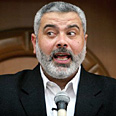
Military prosecution to ask court to extend remand of dozens of organization officials captured in wide-scale operation last week. Defense establishment not ruling out possibility of arresting Palestinian PM Haniyeh
The military prosecution is expected to ask the military courts to extend the remand of the 34 detainees.
"The detention and the expected legal procedure is a continuation of the struggle against the Hamas organization and its infrastructures, from the rank of activists to the highest level, including those spreading the organization's ideology through governmental offices," the military sources said.
Thirty-eight out of the 60 Hamas members arrested following the kidnapping of Corporal Gilad Shalit still remain in Israeli prisoners and are in the midst of different stages of their trials. The Hamas members are accused of membership and activity in a terror organization and of holding a post in a terror organization.
If the Hamas members are convicted, the court may sentence them to up to 10 years in prison. The organization members arrested in recent days are also facing similar indictments, but a final decision on the clauses of the indictments will only be made after the investigation is completed.
Among the new detainees are a number of Hamas members arrested by Israel in the past and released. They were detained once again after new evidence against them was collected.
A military source explained that ministers were arrested and released in the previous detentions after it was impossible to prove that they belonged to Hamas. "This is the reason not all of them are arrested. We need suitable evidence which could be submitted to the court," the source noted.
Asked if Israel plans to arrest the Palestinian prime minister who is currently in the Gaza Strip, the military source said, "From a legal and principle point of view, if Haniyeh visits Ramallah he could be arrested, but these decisions must be made when the time is right. All Hamas members can be arrested, but such decisions must come from the political echelon."
