


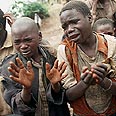
Survivors of Rwanda genocide (archives)
צילום: איי פי
Genocide survivors trade memories
Survivors of Holocaust, Rwanda, and Darfur genocides meet at Jerusalem's Yad Vashem to recount traumas
Three survivors of separate genocides around the world met at Jerusalem's Yad Vashem Holocaust Museum to share their traumatic experiences with an international group of Jewish and non-Jewish youths on Wednesday.
The members of the panel, made up of a survivor of the Holocaust, the genocide in Rwanda, and the ongoing genocide in Darfur, southern Sudan, each recounted the horrors which unfolded around them, and expressed empathy and understanding of one another's experiences.
Dr. Ehud Lev, who lost his parents in the Holocaust, and who was hidden by a family in France after spending time in a concentration camp as a child, said: "I remember the camp very well. So much so that my wife couldn't believe what I was telling her. I remember the suffering of a child at the age of seven. The difficulties of adjusting to the many places I was hidden in, not knowing that by 1942, I was an orphan."
"A child is a child, and suffering is suffering - it doesn't matter if it takes place in Rwanda, Darfur, what religion is involved, suffering is still going on in the world. Genocide is still taking place in Darfur, who is doing anything about it?" Lev asked.
Jean-Marie survived the genocide of Tutsis at the hands of Rwanda's majority Hutu militia and army in 1994. He too lived because he was hidden by a Hutu man, although his mother was murdered by a Hutu militia.
Attempting to overcome emotions to recount his story, Jean-Marie described how he was made to stand up in class and laughed at by his fellow Hutu classmates and teacher for being a Tutsi, and how the media spread incitement and hatred of Tutsis 24 hours a day, culminating in the genocide.
"The media would say that all of the problems of Rwanda were caused by Tutsis, that we were the source of all trouble," Jean-Marie said. "I was called a 'snake' in school. As you know, genocide is a process," he added.
"We are now also facing a denial of this genocide," Jean-Marie said, adding: "That is an awful thing to face."
Speaking to Ynetnews, Jean-Marie said, "When I visited Yad Vashem, I didn't need to hear the explanations of the images I saw. I understood what I was seeing."
'There's a lot to be done'
Yassin Ahdam, of Darfur, described how the Sudanese government backed Arab Janjaweed militias to conduct mass killings of Sudan's southern black indigenous tribes."I woke up from the sounds of gunshots. Soon afterwards, the Janjaweed surrounded my village and opened fire on our homes. They killed a lot of people. The survivors ran towards the mountains to hide. We had to leave behind our grandparents, children, mothers, to die," he recounted.
Yassin Ahdam said the Janjaweed's favorite tactic was to set fire to villages and open fire on those who escaped the flames.
He saw his father, uncle, and cousins murdered in the attack. Later in the day, a helicopter overhead opened fire on the villagers who had survived the assault on their village, killing more people.
Yassin Ahdam eventually found his way to Egypt as a refugee, but encountered racial abuse and intolerance there. He decided to move further north to Israel. "At first we were considered members of an enemy nation by the interior ministry and put in prison," Yassin Ahdam said.
"But then Israelis from aid organizations and Tel Aviv University started to visit us, and pressured the government to let us go. We were also helped by Yad Vashem's chairman, who asked the prime minister twice to help us. Today we live on kibbutzim in southern Israel, and the members of the kibbutz are very nice to us. I have to say thank you to these people who helped us, who struggled to have us released... and to the country of Israel," he said.
The event was sponsored by the World Jewish Congress, and organized by the Director of the Future Generations Division, Peleg Reshef.
"Eventually, these youths who heard the stories today will be brought to Berlin for a huge conference on racism," Peleg told Ynetnews. "There's a lot to be done. This should be an international effort - this is our obligation," he said.
