


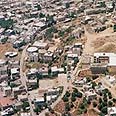
Umm el-Fahm
צילום: משה מילנר, לע"מ
Downtown Umm el-Fahm
Umm el-Fahm wants to grow, develop, host visitors, including Jews, but has an image problem and even though it has an espresso bar, its tourism facilities are nothing to write home about. Is it headed for failure?
When I told my friends and relatives that I was about to visit Umm el-Fahm and write a piece about it, some of them expressed real fear for my life. I must admit that I was sure my editor was pulling my leg when he gave me this assignment. That is how it feels.
 The view from the top is magnificent: You can see the Mediterranean to the west; looking northward you see Mt. Hermon and Syria, as well as southern Samaria; and looking south, even Tel Aviv is visible when the air is clear. In fact, from the top, you can see four countries - Israel, Jordan, Syria, and Lebanon - and another political entity, the Palestinian Authority.
This sentiment presented itself as the lead to this story, which is also the bottom line: a visit to Umm el-Fahm is a reminder that dissociation, alienation, and ignorance surely produce fear.
Muhammad Rabah is painfully aware that Jews are afraid when they visit his town, but he knows how to go around it. I don’t know how it does not offend him, but perhaps he is past that. Rabah is the director of the Regional Unit of the Northern Triangle, guiding groups of visitors who arrive in Umm el-Fahm through the Tagliyot Company. Yes, it appears that people do visit Umm el-Fahm.
Five-state view
The first place that Muhammad Rabah took us was the summit of Mt. Amir (Shaykh Iskander, in Arabic), at 521m above sea level. The way up, climbing through the narrow and twisting alleys of the town, was hard even for Rabah's enormous SUV, but it gave him enough time to fill us in on the efforts currently made to develop tourism there, which he did with real enthusiasm.The view of Umm el-Fahm from the top of Mt. Amir reveals urban chaos. Even the Old City, which is the "downtown," is actually high on the hill. "Our downtown is actually uptown," Rabah said, amused as if it was the first time he noticed that.
Photo: Yonatan Tzur (יהונתן צור)
From there, we went to the Old City to visit the 5-story Abu-Ubeyda Mosque, the largest in town. The bottom floor houses a clinic that will one day become the first hospital in the region, symbolizing the close connection between social/community and religious activities in Umm el-Fahm.
We entered the mosque when it was empty, which gave us an opportunity to admire not only its magnificent and colorful dome, but also the huge and well-lit prayer hall. Rabah did not fail to mention the "Israeli connection," letting us know that the national photo collection carries a picture of former President Chaim Herzog taking off his shoes before entering the mosque.
Alone in town
Emerging from the mosque, Rabah told us he must leave us because he must attend a tour-guides' class in the Bar-Ilan University. We have not seen enough of Umm el-Fahm and the fear that slightly dissolved was back to haunt us, but we decided to go on, alone.The attempt to check out the local market failed. At noon, it was nearly empty. We were told that evenings and weekends are good for a real impression of the shops and shoppers. So we decided to visit the Umm el-Fahm art gallery instead.
The gallery was established in 1996 by director and artist Sa'id Abu-Shakra. It carries works by Jewish and Arab artists and is presently considered the only meeting point for Arab artists. It is very successful. In the future, it will become "the Umm el-Fahm Museum for Contemporary Art," Abu-Shakra told us, and has recently issued a guidebook for the city, presenting its main attractions, complete with maps and full information.
Touring the town without Rabah gave us an opportunity to meet and hear others. Shortly before our tour ended, two youngsters sitting outside a coffee house (which used to be a butcher shop, as its sign still indicates) talked to us about their discontent with Umm el-Fahm. They did not see more tourists coming, they do not believe the town offers enough employment or social welfare to its residents, and are aware of the fact that the Jews believe Umm el-Fahm is dangerous. "If I could, I would leave this country and never come back," Mahmud Abu-Dris told me.
Red October
The riots of October 2000 created Umm el-Fahm's negative image, gravely hurting its tourism and catering businesses, as well as the furniture factories that used to attract buyers from all over Israel. Over the past two years, several projects were initiated intending to improve the town's tourist, cultural, and business potential.To an outsider, Umm el-Fahm looks like it still has a long way to go before it becomes the attractive town its elders would want it to be. On the other hand, its backwardness is its charm: children running around the narrow alleyways, half-built houses, shrubs and greenery on the balconies, the little shops, the local food - all reflect some fleeting yet complicated truth, full of contradictions, that lies just beneath the surface, remaining unreachable.
