


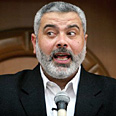
Haniyeh calls Sharm summit a farce
In Gaza speech, dismissed Palestinian prime minister says 'our land will not be returned through these summits – only through resistance'. Hanyieh accuses Israel of taking advantage of internal Palestinian situation
Israel is taking advantage of the internal Palestinian situation, dismissed Palestinian Prime Minister Ismail Haniyeh said on Sunday.
Speaking in Gaza, Haniyeh accused Israel of political manipulation, saying that Israel was tightening the embargo on the Strip on the one hand, and releasing money to the West Bank on the other.
Haniyeh added that while Israel was organizing the Sharm el-Shiekh summit, set to take place on Monday, it continued to arrest Hamas activists in the West Bank.
He warned the Arab world not to get caught up in the Israel-Palestinian summit "trap", saying "this is like sprinkling sand in our eyes.
"The Israelis and the Americans won't give us anything. Our land and our rights will not be returned to us through these summits. We will only get our rights back through resistance," he said.
Earlier on Sunday Palestinian President Mahmoud Abbas said he received US and Israeli assurances that the Jewish state was ready to make progress at the summit meeting in Egypt, the official Jordanian news agency Petra reported.
But in Jerusalem, Israeli Prime Minister Ehud Olmert played down expectations ahead of the summit, telling his cabinet not to expect a "dramatic breakthrough" at the gathering, according to a meeting participant.
Haniyeh added that he was not troubled with the transfer of Palestinian tax funds to the West Bank, saying this was the right of the Palestinian people.
Nonetheless, the former prime minister said the tax money to be received was a bribe, and that the Israeli intervention proved that deepening the PA crisis was in the occupation's interest.
"Our main problem is with the enemy and the Israeli occupation. Any internal conflict will not distract us from the fact that our main battle is against the occupation," Haniyeh said.
Haniyeh continued to describe the political pressure he said was put on his party. "Immediately after our first government was assembled, we were faced with political pressure on the government and on our people.
"The pressure came in the form of the international Quartet's conditions, which are nothing but political pressure. The goal of the pressure was that we would give up our resistance and recognize agreements, and if we don’t, we will continue to be isolated," he said.
Haniyeh said that in addition to the political pressure that was placed on his government, the Palestinian people were also put under great economic pressure.
'Dangerous plot against Palestinian people'
The former prime minister added that Israel damaged the Palestinian Legislative Council, headed by Hamas, by arresting 45 parliament members, including 40 Hamas men and the Legislative Council's chairman.
"These steps made by Israel were accompanied by an internal attempt to sabotage the parliament's work. In addition, an internal rebellion was created in the Palestinian Authority, which came in the form of our authorities being taken away, and every time we solved a problem, another problem would pop up.
"This proves that robbing us of our authority and placing obstacles in our way were part of a well-planned rebellion against us."
Besides damaging Hamas, Israel decided to provide Fatah with money and arms, Haniyeh said, adding that this "is proof of a dangerous plot planned against the Palestinian people.
"The Fatah envoy that visited the United States was given explicit orders from the American officials he met with to topple Hamas by force. This information was given to me from a source who participated in the meeting."
Speaking of the relations between his party and Fatah before recent clashes broke out, Hanyieh said, "We were willing, despite our great majority, to give central government offices to independent bodies.
"We strived to find common ground between the Islamic viewpoint that strives for all of Palestine and the national viewpoint, which aims for establishing a state in the 1967 borders."
In his speech, Haniyeh also criticized American and British leadership, saying, "Despite the Mecca agreement, and Hamas' concessions and flexibility, a Fatah official told me that the Americans and the British are not pleased with the agreement."
