


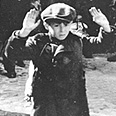
The Poles remember; do we?
Despite criticism at Brussels summit, Polish leaders refuse to let Germany forget its dark past
Talks about the new European treaty aimed at substituting the constitution that failed in referendums were conducted last week on behalf of Poland by Lech Kaczynski and his twin brother, Jaroslaw – the former a president and the latter the prime minister.
Lech sat in the session halls in Brussels alongside a translator and a phone line to the chambers of his brother Jaroslaw - the hardened and sophisticated of the two and the one who calls the shots. The German press named Jaroslaw Kaczynski the "bad brother," and spared no criticism at Poland's behavior during the Brussels summit.
And indeed, those Poles are full of chutzpah: Not only did they dare oppose the proposed change in the voting system that elects the ministers of the European Council; a modification that would have doubled the relative power of the larger states - particularly Germany's – but they also dragged Poland's history into the summit – a history of humiliation, downfalls, betrayals and conquests, which even now remains at the heart of Polish cultural discourse.
It suffices to walk into any bookshop in Warsaw to see the pile of new books on historic topics being grabbed off the shelves.
In a rare interview, the Polish prime minister said: Germany should not flaunt its demographic and economic advantages and feel superior. It should remember that it was Germany that launched World War II, that it was Germany that attacked Poland and took it over, and that it was German soldiers who murdered millions of Polish citizens.
If not for this, he said, Poland would currently have a population of 66 million as opposed to 38 million.
Kaczynski's statements infuriated some of the 27 heads of state attending the unification summit in Brussels. At the heart of the idea of a United Europe is a decree to forget past disputes, bury history and annul the settling of scores. This forgetfulness is a precondition for reconciliation and for building a common future.
Alas, suddenly, two provincial Poles came along and proceeded to dig up the unpleasant matter of that thing called World War II. Shame on you, you Poles, the European press lashed out at the brothers Kaczynski, what made you remember Germany's guilt only now? How disappointing that contrary to your image you have no table manners; there are things that are no longer discussed in our parts.
Was it worthwhile?
By the end of a full day of tense discussions the twin brothers got their way: Germany's de facto control over European unification would be postponed for several years.
The way in which Poland got its way raised harsh questions in Warsaw itself. Was it worthwhile, wondered the Poles, to anger Angela Merkel, Germany's popular chancellor who lost her equilibrium in face of the Polish chutzpah?
Was it worthwhile stirring the ghosts of that Germany – a Nazi, conquering, murderous Germany, and to be depicted as Europe's troublemaker? To lose friends for the sake of the principle of equality between nations, a principle that the bureaucrats in Brussels will inevitably dilute, bend and dissipate?
Yes it was worthwhile; very worthwhile.
I traveled to Poland this week to attend the laying of a cornerstone for an impressive Polish enterprise: The building of a museum commemorating the history of the Jews of Poland in the heart of Warsaw, opposite the monument of the ghetto revolt, at a cost of tens of millions of dollars to the public coffers.
But I also went there to tell my concerned friends in Poland: I bow in appreciation to your stance at the European treaty summit. It is commendable that there is still someone on the European continent – where political correctness is destroying all independent thought – who remembers who the aggressor and who the attacked were, who the victims were and who the murderers were - someone who remembers and says so out loud.
The Holocaust has not been forgotten over the last two decades, yet somehow it, as well as other World War II atrocities, has shifted from their German origins.
As though the war crimes were perpetrated by some mysterious barbaric tribe outside of Europe, far from its beautiful capitals, and for a while forced itself on the lofty German-European culture and forced it against its will to conquer, murder and exterminate.
This pagan tribe deserves every form of condemnation; but Germany? Our Germany? Our Europe? How ridiculous. Europe and the Nazi atrocities have nothing to do with each other.
But they do. Fascism and Nazism are both the offspring of Europe. They are both significant components in European culture throughout the generations. Fortunately the Poles refuse to forget this; it's a shame that we have.
