


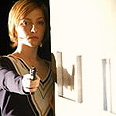
Scene from the play, Hedda Gabler at the Camari
A Norwegian and a German meet in Tel Aviv
Sounds like the beginning of a joke? Not really. It's Ibsen's Hedda Gabler, performed in German at the Cameri Theater. Noa Raz was not impressed
Sometimes ignorance is bliss, especially when it comes to writing a review. Why do I open with this somewhat apologetic sentence? Because - unlike my learned colleagues - I find it difficult to rave about the German Schaubuehne Theater's production of Hedda Gabler. The performance in Tel Aviv that was a joint effort of the Cameri Theater and the Goethe Institute received many superlatives and is considered a masterpiece. But it did not work for me.
I'll start with a compliment: the set was phenomenal. The combination of a rotating stage, mirrors that reflect all angles of the stage, the video clips in the background and the perfect replication of a room, made the night a real visual treat. On the other hand, a production that relies on such a sophisticated set, seems problematic from the get go.
_wa.jpg)
Magnificant set (Photo: Courtesy of the Cameri Theater)
To deal with the German text, the Cameri opted to go with subtitles. However, in the massive hall, where the actors' voices were at times unheard, the non-German- speaking audience had to spend the night staring at the subtitles that distracted one's attention from the events on stage.
I also did not agree with the director, Thomas Ostermeier's adaptation. You may call me a purist, but there's a limit to how much changes you can make in a play and still claim it is the real thing. Ibsen's Hedda Gabler is one of the most clever, multi-layered plays around. The German version – at least as it was presented to the average Israeli who does not speak German – was half empty, focusing only on a fraction of the play's conflicts.
I am all for artistic freedom, and I do not shy away from some artistic chutzpa, but erasing a character – as secondary as it may seem – is problematic to say the least. I also take issue with the director's choice to use physical, at times sexual, contact between the actors as the sexual tension is one of the play's cornerstones. When that is gone, so does some of the play's strength.
On the other hand, sometimes we need to separate the outcome on the stage from the original. In this case, Schaubuehn's Hedda Gabler is an interesting play with some brilliant elements, and talented actors who managed to overcome the language, culture, and sound system's barriers. The young Annedore Bauer deserves special praise for her ability to portray Thea's heartbreaking neuroses.
