



Blogging to the beyond
Eyal Benin and Alex Schfilovitz were deeply in love until he was killed during Second Lebanon War. Now Alex writes to him in an internet blog
“I just decided that you should occasionally hear what’s happening here with us, and how everyone’s managing without you, even though I don’t exactly know how we really will manage.” (Entry 1, July 21, 2006)
Ever since her boyfriend was killed, Alex has been writing weekly letters to him on her personal blog. She tells him about the difficulties, the experiences, the longings, and the numerous events of everyday life.
Basically, she tries to keep him up-to-date. “It’s not that I believe that he can read it,” she admits. “But it helps me to tell him everything, even if he isn’t here.”
Much of the time, she addresses him in the first person – as she used to, before the war. Her letters contain messages that only he would understand; private jokes, and references to shared experiences.
She concludes each letter by declaring her love – for a lover who’s no longer among the living.
Sergeant-Major (res.) Eyal Benin and Alex Schfilovitz were together for four years. A year ago, the future looked bright. The couple was planning a trip to China, and then they were going to live together in Jerusalem, where Eyal was going to study at the Hebrew University.
Now, a virtual diary and painful memories are all that remains.

Alex, at home, writing to Eyal
On Wednesday morning, July 12, 2006, Eyal, 22, an IDF soldier in the 5th Brigade, was killed during a Hizbullah attack along the northern border. Two other soldiers – Ehud Goldwasser and Eldad Regev – were captured during the same attack, which served as the catalyst for the outbreak of the Second Lebanon War.
Alex will never forget that morning. “His mother called and said that there’s chaos in the North and asked if I had heard from him,” she recounts. “I called him, but there was no answer.
“At 4:00 pm, my cell phone rang, and a foreign number appeared on the screen. The mother of a friend was on the line. ‘Eyal’s been hit,’ she said in a broken voice.
“’What do you mean “hit”? Is he in the hospital?’ I asked. ‘No,’ she answered, ‘Eyal has been killed.’”
“You promised me that you were bulletproof. Yes, yes, I know that I remember things too well, and I also remember this. It was explained to me in great detail that when a bullet hits you or one of your crowd, it doesn’t penetrate; it jumps to the side. I even prepared a shirt for you with the Superman logo and the words ‘Bullet Proof’ underneath.” (July 22, 2006)
They first became acquainted during high school in Beersheba. Eyal and Alex were in parallel classes and knew each other by sight. When his parents divorced, Eyal moved to Tel Aviv, but during a trip to Poland, he met Alex again.
“We got together during the trip, and we became friends,” Alex reminisces. “We’d meet from time to time, and we’d talk on the phone. At that time, I had a boyfriend, and Eyal had these stormy, dramatic love affairs, which he’d consult me about and share them with me.”
When Alex was 18, her mother died of cancer, after being unconscious for six months. Alex’s personal tragedy brought her closer to Eyal, who had meanwhile enlisted in an IDF Nahal unit. The two became a couple.
“It felt right as far as we were concerned,” Alex observes. “We said: ‘let’s try it.’ And the experiment worked.”
Eyal’s family was very nervous during his military service. “He was an only child, and his parents signed a permission slip allowing him to serve in combat duty,” Alex states. “There was anxiety in the air, and everyone was on guard.
“After all, the army is dangerous. You’re not playing with Lego, and you can even die. He and his friends would laugh about it, and they weren’t scared. During that stint of reserve duty, he was more afraid. Maybe because he suddenly realized what he had to lose.”
The two grew ever closer. Eyal would spend his vacations with Alex, after visiting his many relatives and friends. His crowd called themselves the “Band of 18”; they had all grown up together in Omer and later served together in combat units.
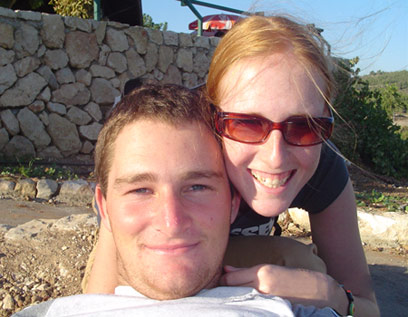
Alex and Eyal on a trip to Jerusalem. September 16, 2004
Eyal was known as “the chief of staff”; Alex explains why. “He was very assertive, convincing, and self-assured. He could answer any question – even if he hadn’t the slightest idea what he was talking about. You’d finally just say: ‘Fine. The guy seems to be correct.’
“Moreover, he was very involved, and he invested a lot in his friends. Everything about them interested him: every personal story, even the smallest detail. He would pay attention, ask questions, and be interested.”
The separation that wasn’t
In November 2004, Eyal was demobilized and moved to Beersheba, where the couple rented an apartment in the D neighborhood. Nine months later, Eyal went backpacking with his friends in India, Thailand, and New Zealand, and Eyal and Alex broke up.“We said that things could change, and there’s no reason that we should wait for one another,” she reports. “But, in actuality, it wasn’t farewell. We’d talk on the phone all the time and write to each other.”
After remaining abroad for six months, Eyal returned earlier than planned due to his grandfather’s illness. The couple got back together immediately. “It was strange, mostly because it was the same thing, as if half a year hadn’t gone by. We both were surprised by how easily we got back into the routine of being a couple.”
Eyal moved with some friends into a rented Beersheba apartment near the one shared by Alex and her roommate. He found a job in a bookstore and was accepted to Hebrew University’s law school in Jerusalem. Alex had meanwhile graduated with a degree in biology and agreed to move to the capital with Eyal.
“I remember that we once happened to watch a program on Yom HaZikaron (Memorial Day) about girlfriends who lost their boyfriends and about how people don’t treat them like widows, and they don’t get recognized. And they showed these girls who cried on camera about their miserable situation.
“You watched it contemptuously, I have to admit, and you said to me, ‘Promise me. If I die in the army, no matter what, you won’t cry on television.” (April 21, 2006)
“He would make me laugh a lot,” Alex recalls wistfully. “That’s what I need from a mate, that he’ll make me laugh and laugh at my jokes. I really loved how he would be enthusiastic about things, fervently and with never-ending passion - the complete opposite of me.
“He totally loved people and charmed everyone around him. He also loved to read, and buying books was a real treat for him.” She then adds, “Eyal was the messiest person I knew.”
For her birthday, he once wrote up a comic list of rules for dealing with an incorrigible slob like himself. Alex tries not to cry as she reads, “He’s a well-oiled machine with 21 years of messes. Therefore, patience is the key.”
Death was a frequent topic of discussion. Eyal joked that he didn’t think his father would cry at his funeral. “You must know that your father did cry,” Alex wrote in her blog, a month after his death. “In contrast to what you thought.”
At a funeral, Eyal told Alex, “No matter what, we won’t be buried in Beersheba.” He preferred to be buried in a green area; during his army service, he assured Alex that he was bulletproof.

Eyal in India
“Yesterday they reported to us with the results of the investigation. Don’t think that your death occurred without many hours of meetings, testimonies, recordings, and bourekas. Yesterday there were also pastries but everyone was either too polite or shocked by the scene. So only the casualties’ officer ate, and that was only at the end, when no one noticed.
“Anyway, it turns out that all sorts of people were out of line – what a surprise. You were fine; remove the worry from your heart.” (November 20, 2006)
Two months after his death, Eyal first appeared to Alex in a dream. “In the dream, you simply come back,” she blogs. “Just like that. You appear at the door, or you suddenly show up at some social gathering.
“And you look as you always do, as if nothing had happened. Everyone came, and you came a bit late. Everyone is amazed, and they ask: ‘How can this be? We were at the funeral; they buried you.’ But you don’t answer. You just shrug your shoulders.”
Alex confesses that she constantly relives the horror she felt when hearing the news. “It was such an enormous shock that I thought I wouldn’t be able to get up in the morning, that it was so awful that I would never be able to get over it.
“How can something like this happen and then people go on living? How does one cope? But my life didn’t stop. I went back to work; I finished my exams. Today, my life isn’t unbearable; it’s just sad.”
'How will I find someone like Eyal?'
Recently, Alex has been looking for a new apartment. She decided that she no longer wants a roommate and would prefer to live alone. “Suddenly, in the middle of the search, I stopped and looked at my life.“And I said to myself: ‘What’s going on here? This wasn’t supposed to happen.’ I planned my life in a different place with a man whom I was very attached to, and suddenly, I’m alone. I lost the man that I loved, and my life was ruined as well.”
In one of her blog entries, Alex discloses that she met another man but he got cold feet. “I know that’s how life goes and that I’ll have someone. But I ask myself what I’m looking for in a guy, and Eyal was everything I wanted. How will I find someone like him?”
“I won’t pretend here that I should be called ‘the pathetic one’, who – every time it seems to her that the situation is good – something terrible happens. The universe isn’t really against me.
“Other people lost their mothers, and other people lost you. These things don’t really happen just to me, and bad things happen to other people as well.
“At the end of the day, there are always children dying of hunger in Africa. Everything can be put in perspective. I just no longer remember this feeling – of peace and happiness.” (January 7, 2007)
Devastated by Eyal’s loss, Alex consulted a psychologist, who pointed out that Alex hadn’t yet come to terms with her mother’s death from cancer either. “She claimed that I hadn’t dealt with it as I should’ve. Perhaps she’s right,” Alex concedes.
She holds her mother up as a role model. “Mom was a fighter, nothing to do with the disease. She came to this country from the Ukraine together with Dad, and they worked very hard in order to make do.
“She never once complained, and she always believed that everything would be fine in the end and that everything would work out in the best possible way. I, on the other hand, was always serious, and it could be that Mom’s disease matured me.”
Although fate dealt her a double tragedy, Alex doesn’t feel the need to search for a scapegoat. “I live a normative life, and I don’t hide the awful truth. But sometimes, it’s very hard for me.
“My life changed instantaneously. In Mom’s case, even though I was optimistic and I believed that she would recover, she was sick for a long time and was in a coma for half a year. So, it was a process. It wasn’t sudden like with Eyal. Suddenly, in one second, I had nothing.”
Thousands of people access Alex’s blog. Readers leave sympathetic comments and say that they share her pain. Some even suggest that she compile her letters into a book.
“There’s something very supportive about people’s ‘feedbacks’ (comments),” Alex says gratefully. “The support is very encouraging and eases the pain.”
She blogs less often these days. “In the beginning, there was a flood of emotions, and I wanted to write and vent from the heart. Today, I don’t really have that much to say, and whatever I write won’t really be new.
“What should I write? That’s it’s difficult for me? I’m not someone who cries and complains. It’s not my nature.”
Alex can’t believe that an entire year has elapsed since her world fell apart. “This year went by so quickly. It’s hasn’t sunk in that so much time has passed. I never would’ve imagined that this is how I would be a year later.
“I’m surrounded by people who love me. I’m healthy, but it’s different. I thought I’d get over it, that I’d recover. But I haven’t.”
“I never liked changes. I’m not a brave person, and deviation from the routine tends to scare me rather than excite me. Each time that something new started in my life, which I knew would continue long term, I immediately wanted to hit ‘rewind’ and go back to how things were before.
“There’s something new in my life, and it’s not going to disappear. It’s just that university spans three years and the service – one year. But you’re never going to return.” (August 28, 2006)
