


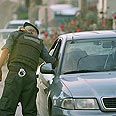
Tax Roadblock
צילום: כיל יוחנן
Petition: Stop 'tax roadblocks' in east Jerusalem
Association for Civil Rights in Israel demands that National Insurance Institute stop collecting debts using police barricades, which they say should be used only for security checks
The Association for Civil Rights in Israel petitioned the High Court of Justice on Wednesday in a demand to stop the collection of debts from east Jerusalem residents through "tax roadblocks".
The roadblocks are used by the National Insurance Institute and the Jerusalem Police to collect debts from residents "in ways used by criminals in the grey market, through extortion, threats and deadlines," petitioners said.
According to the petition, which was filed by attorney Tali Nir on behalf of four east Jerusalem residents, "these roadblocks are being operated without any legal authority and are harming human rights."
The "tax roadblocks" are usually set up once every week or two on main roads between Palestinian neighborhoods. Every vehicle passing by is stopped, and its owners are required to pay their debts on the stop or have their car confiscated.
The petition mentions the story of one of the petitioners, Dr Adel Manna. The man, a historian, left his east Jerusalem home one morning in March 2007 and drove toward the Hebrew University on Mount Scopus.
After a short drive he was stopped by police officers at a roadblock. After he presented his identity card, the officers told him that he had a property tax debt of NIS 7,400 (about $1,733). Manna was ordered to pay half of the debt in cash within 30 minutes, or have his car confiscated and towed.
Although Dr Manna offered to pay all his debts by credit card or check, the officers confiscated his car. He withdrew the required sum from a nearby bank and returned to the roadblock where he paid his debts and was given back his car.
