



How does the army creep into society?
This question will be answered by female peace activists from Israel, the United States, Serbia, Russia, South Korea, and Zimbabwe in a seminar called Gender and Militarism. 'Manipulating the masculine and feminine perception is a one of the means used to make the civilian society join the war effort,' the organizers say
Dolev will present her theories in the end of August in Neveh Shalom, where a seminar on Gender and Militarism will be held. Initiated by New Profile and organized by The Coalition of Women for Peace and WRI, the international antiwar movement, the conference the will last four days, including the seminar, with speakers from Israel, the United States, Serbia, Russia, South Korea, and even Zimbabwe. Among other things, it will address issues such as the connection between military service and violence in the family, militarism in culture, the Palestinian feminist movement, and conscientious objection by women.
"The army and wars shape the way people perceive security, and violent conflicts impact on the way the society makes a distinction between the private and public domains," the organizers explained. "The way we see it, the presence of belligerent violence supports violence against women in the family, and the presence of feminism is impossible without analyzing this issue.
"Manipulating the masculine and feminine perception is a one of the means used to make the civilian society join the war effort," the initiators stated.
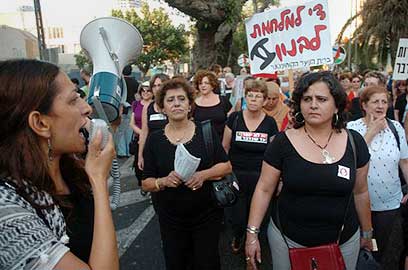
Protest: "War is a masculine phenomenon" (Photo: Avi Cohen)
"The message is clear: Army and society are intertwined"
But why focus on the architectural aspects of Israeli militarism? Dolev explained that this is "the missing link in the connection between culture and militarism. I named it so," she went on, "because most people step into buildings without paying attention to the way they were designed. People view buildings functionally, or treat them like some inevitable force of nature. In practice, however, political and cultural perceptions are embedded in their planning process."
The location of the Kirya, the IDF headquarters, is a clear example of the relationship between army and society in Israel. "Who ever heard of a situation where a military base is built in the middle of a big city and, on top of that, it is the army's high command post?" she asked. "This does not only put the lives of civilians there at risk, but also delivers a very clear message: army and society in Israel are intertwined."
Dolev described the way architect Moshe Safdie designed the new Yad Vashem building as an attempt to conceal national messages. "The old building was more practical. If you could not take the sights anymore, you could walk out," she interpreted the design. "In the new building, however, you must get through the whole thing to get out. You are not given an option to skip a stage." Another message is delivered by the window at the end of the path, overlooking Jerusalem and the mountains around it. "Coming out of Yad Vashem, you walk into the light, toward redemption," she stated.
In her lecture, Dolev intends to address aspects pertaining to cinema, commercials, and TV. "The extensive use made of soldiers in commercials has turned the soldier into the 'national son,' but we tend to forget that he is a warrior, trained to kill. Even the frequent use of the term 'contribution to the state' carries some fascist elements. I do not want to contribute to the state; I want to make my contribution to the society," she said upset.
"And what about the Arab and strictly Orthodox sectors that do not serve with the IDF? If this is the only way to make a contribution, regardless of what you do with your life, than those who do no military service simply make no contribution at all."
So, whose is bigger?
The invitation to the conference presents some interesting questions: "Does being a real man means you have to walk around with a gun? What is the connection between war and rape? How does the army impact on the structure of civilian society worldwide? What is the connection between conscientious objection and respect for women?"
Yana Knopov, an activist in The Coalition of Women for Peace and a speaker at the conference, believes the army and violence against women are closely connected.
"War is a masculine phenomenon. There is something very irrational and very hormonal about it," she declared. Last summer, Knopov led the protest against the Second War of Lebanon, "which was a rational and feminine protest against masculine madness. A group of men got together and decided to go to war within 40 minutes," she protested. "As a result, we had a war that was motivated by the desire to show whose is bigger, a sort of national erection."
Another issue that the seminar will address is the transfer of military patterns into civilian life. In this context, the fact that women have managed to join combat units that used to be masculine strongholds is actually a feminist's mistake, Dolev claimed.
"Women that want to 'contribute more' assume combat positions, seeking more action, which is where they actually become more masculine, while women soldiers that remain on the traditional feminine posts are still no more than pretty ornaments in the office. This pattern indicates that you cannot both contribute and be a woman at the same time, which is something we need to struggle against."
Gender and Militarism seminar, August 26-28, Neveh Shalom. For more information, click here.
