


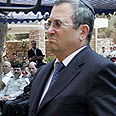
Defense Minister Ehud Barak
צילום: דודי ועקנין
Barak shuns Left
Formerly leftist Labor chairman adopts rightist views in order to boost his political standing
In his first 100 days at the 14th-floor office in the Defense Ministry headquarters in Tel Aviv, Ehud Barak managed to position himself on the right side of the political spectrum – in contradiction to views he himself voiced in the past.
The tables have turned: The man, who during his term as prime minister in 2000 proposed a withdrawal from 90 percent of the territories including Arab neighborhoods in east Jerusalem, is using Benjamin Netanyahu-style rhetoric and saying there is no partner on the Palestinian side and that an agreement with the Palestinians is no more than a fantasy.
Barak's actions are commensurate with his talk: The man who at the end of his premiership term, and without any public legitimacy, proposed far-reaching concessions at the Taba talks and was willing to forego Israeli sovereignty over the Temple Mount, is now making a big deal out of the evacuation of 24 tiny outposts in Judea and Samaria while offering the Palestinians meaningless concessions, such as the possibility to bring in 500 police officers into a Palestinian town during the day.
Ehud Barak, who used to be the great hope of the Israeli Left, declares now that Israel cannot withdraw from another inch of land before a defense system that can intercept Qassam rockets and missiles is developed and completed – something which at the very earliest will only happen five years from now.
Preparing to strike Gaza
And if all this is not enough: Instead of backing Prime Minister Ehud Olmert's talks with Palestinian leader Mahmoud Abbas with a series of moves to ease life in the territories, Barak refers to these talks as "hot air" and "disconnected from reality."
At the same time, Barak is preparing the ground for a wide-scale ground operation in the Gaza Strip. He has already declared on several occasions that every passing day brings us closer to such operation.
Barak's conduct is stirring anger among his Labor party colleagues. Recently, they decided to offer their support to the negotiations with Abbas – in contradiction to Chairman Barak's views.
Members of Barak's party, but also members of Kadima, are wondering about the reasons behind Barak's odd about-face. The commonly accepted explanation within the political establishment is that Barak is conducting himself this way on the recommendation of his strategic advisors.
The logic behind his conduct is that on the one hand, Barak must erase from public memory the far-reaching concessions he offered when he was serving as premier, which led to his ousting from the Prime Minister's Office, while on the other hand he must distinguish himself from Olmert, who is currently proposing a diplomatic process.
One thing is certain: Barak will find it difficult to maintain this line over time, and at one point or another he will have to reassume the role that the political establishment designates for the chairman of the Labor party – that is, the leader of the Israeli Left.
