


Defying borders
Yad Vashem Holocaust Memorial to launch new Arabic-language version of its website in January. 'The power of the internet is that it enables users to circumvent the authorities,' museum officials say, pointing to warm responses from Iranians using the year-old Farsi site
It's no secret that the Holocaust is not taught in schools in Muslim countries and that the absence of relations with Israel renders the relevant information inaccessible. In the eyes of Yad Vashem, the internet is an excellent tool for the distribution of information, be it scholarly studies, articles, survivor testimonies, or photographs.
"The power of the internet is that it enables users to circumvent the authorities," Yad Vashem President Avner Shalev said. "If openly reading a book on the Holocaust in a Muslim country can cause problems, the internet is an open space that defies borders."
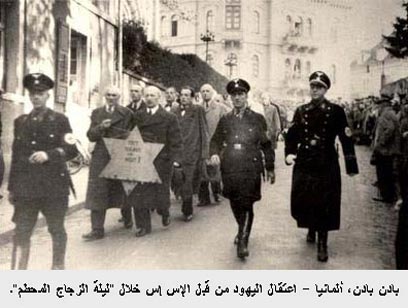
Mass arrests of Jews during Kristallnacht
According to Shalev, moderate, liberal Islam, in conflict with the extremists, is formulating a response to growing manifestations of Holocaust denial. "This is a process which is gaining strength and must not be ignored. Moderate Islam is displaying awareness of the subject and understanding that Holocaust denial does not serve its interests," Shalev said.
"it is for this very reason, that we see it as important to lend a hand to (moderate Muslims) who are interested, to aid in the expansion of knowledge and to give them the information and tools for dealing with Holocaust denial."
A sensitive process
The Arabic section of the site, to be launched January 27 on the occasion of International Holocaust Remembrance Day, will contain pictures from Auschwitz documenting all the stages which Jews underwent after arriving at the camp on transports in the summer of 1944, from the moment they alighted to that of "selection." Also included will be the personal stories of Albanian Muslims who saved Jews during the Holocaust.
Dana Porat, responsible for the site's content, emphasized the extremely sensitive nature necessary in choosing materials to translate. "We wanted to eschew sensationalism," she said. While many portions of the Hebrew webpage will not immediately find their way into the Arabic one, Yad Vashem has placed an emphasis on the historical aspects of the tragedy in order to avoid politics.
"We know that the Arabic site will not change the opinions of Holocaust deniers, but this is an explicit attempt to confine and marginalize them through spreading knowledge," Shalev said. "Yad Vashem is not a political entity. It would be a horrible mistake to tie the Holocaust to contemporary politics, as this will derail the discussion and give rise to arguments unconnected with the (Holocaust) itself."
Encouragement from Iran
According to Porat, the Farsi site recorded around ten thousand hits in its first few weeks online. "This is an enormous number which definitely encouraged us to proceed with the understanding that people are hungry for information," she said. "We received very exciting responses that often evinced a sense of discovering something for the first time."
As an example, Porat chose to quote a letter from an Iranian user: "I am an Iranian. It does not matter, I am human…. I am sorry that the president of my country gives crazy speeches against the Holocaust and (for me) it is unimportant how many people were killed in the Holocaust. Even if only one baby was murdered, this is a holocaust in my view and a mark of shame for humanity.
"Today, for the first time, I entered Yad Vashem's Farsi webpage, and although I know what the Jewish people underwent, what I saw and read touched me deeply, which is why I am writing you. I believe that what we see today throughout the world, whether in Islamic countries or in Europe, is the continuation of that same anti-Semitism that brought about this tragic genocide."
