


Report: Ratio of hospital beds per capita lowest in the West
The Association for Civil Rights in Israel publishes damning new report on the dreadful state of the public health system and discrimination by public institutions against certain groups: the poor, immigrants, and Arabs
Israeli health services are coping with a serious erosion in government funding which is sending ripples through the health system, with hospitals hardest hit. This is the picture that emerges from the annual report of the Association for Civil Rights in Israel (ACRI), published Sunday.
The report also brings to light harsh statistics concerning discrimination by public institutions against different populations, including residents of outlying areas, the poor, day laborers, immigrants, Arabs, and prisoners.
The document's first chapter, entitled "It's better to be rich and healthy," presents statistical evidence of er
osion in government funding for public health services.
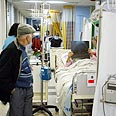
Thus, in the past seven years, the health budget has decreased 14%. These funding difficulties have caused a crisis in hospitals, where the ratio of hospital beds to citizens is now the lowest in the western world, 1.94 per 1,000 Israelis. In 1970, almost four decades ago, the ratio was 3.27 per thousand.
The report similarly deals with day laborers, revealing that the average salary of placement agency employees stands at 60% of the workforce average. The ACRI claims that the state itself has saved millions of shekels by hiring contractors who employ such workers, while the Finance Ministry attempts to quash legislation aimed at regulating the issue.
According to the chapter on unrecognized Bedouin villages, there are currently 80 thousand people living in these communities which the state refuses to recognize. The residents live in areas without municipal services or legal building permits, and thus, in 2007 alone, 200 structures in the Negev were demolished – a new record even when compared with the dozens of demolitions that have taken place every year in recent memory.
Regarding alleged criminals, detainees, and prisoners, the report addresses a newly passed law which makes it possible to extend detention through the use of video conferencing, which the ACRI claims "severely damages detainee rights, especially the right to be present during one's sentencing."
Disturbing signs of racism on the rise
Certain segments of the report pertaining to Israel Arabs were published last night. In their research, the ACRI found an increase in hateful sentiments among the Jewish public, racist law-proposals in the Knesset, humiliation at the airports, restrictions on free speech, and discrimination in the distribution of funds for rehabilitation to Arab communities in the North.In addressing racism towards Israel's Arab population, the ACRi employs some disturbing statistics to back up its claims: over half of those surveyed in a poll of the Center Against Racism published in March 2007 declared that they would not agree to live in a building with Arabs, did not want Arab friends, agreed on segregating Arabs and Jews in recreational activities, and believe that Israel should encourage the emigration of its Arab citizens.
In 2006, the number of racist incidents against Arabs climbed 26% from the previous year, and other surveys have indicated an increase of almost 100% in feelings of hatred the Jewish public expresses towards the Arab minority.
