


Negotiations on core issues begin
(VIDEO) Livni, Qureia meet in Jerusalem, agree to continue talks away from spotlight. Meanwhile, Prime Minister Olmert tells Knesset's Foreign Affairs and Defense Committee, 'The two-state vision refers to one Jewish state and one Palestinian state, not to three states for two peoples – the West Bank, Gaza and Israel'
The two leaders agreed to meet again soon to continue the negotiations, away from the spotlight.

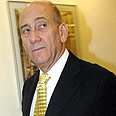
Meanwhile Monday, Prime Minister Ehud Olmert addressed the negotiations with the Palestinians during a meeting of the Knesset's Foreign Affairs and Defense Committee.
After referring to issues related to the Iranian nuclear program and to a possible military operation in the Gaza Strip, Olmert spoke about the implementation of the understandings reached at the US-sponsored peace conference in November.
"The talks have been going on since Annapolis at the aim of creating an agreed upon pattern for moving forward," the prime minister said. "We reached a joint understanding that the different issues must not be separated, and that each sub-issue should not have a sub-committee, because the split is not necessarily beneficial.
"We preferred that the team heads – Livni and Abu Ala (Qureia) would be directly responsible for the discussion of all issues, and would be able to bring in relevant experts to each discussion."
Addressing the core issues, Olmert said, "We cannot only deal with the marginal problems, and claim that these are serious negotiations. We will have to deal with all the basic problems standing between us and the Palestinians.
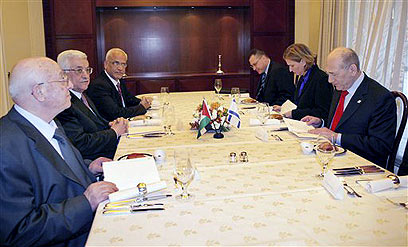
Israeli and Palestinian negotiators meeting in December (Photo: AP)
"We shall not deal with these issues with an immediate frontal attack. We distinguish between continuous security and future security arrangements, which should guarantee the State of Israel's ability to defend itself against any situation which may evolve.
"We do not distinguish between the Judea and Samaria and Gaza, and don't plan to be tempted by the opinion that since the PA does not control Gaza at the moment, we should concede our security demands regarding the Strip.
"The two-state vision refers to one Jewish state and one Palestinian state, not to three states for two people – the West Bank, Gaza and Israel.
"If someone would ask Abu Mazen (Palestinian President Mahmoud Abbas) today if he is interested in the existence of a temporary state without Gaza, I doubt whether he would respond positively. In any case, as far as we are concerned, the responsibility for implementing the first stage of the Road Map refers to the Gaza Strip as well."
'Status Quo – dangerous and irresponsible'
The prime minister also spoke about his doubts regarding the diplomatic process, saying, "I am not sure we can reach an agreement and I am not sure we can reach an implementation, but I would be betraying my job and the State of Israel if I didn't give it a chance. In fact, the government today offers the only responsible option in the diplomatic field.
"The opposition and the opposition leader want a status quo at any cost. I say this is dangerous, adventurous and irresponsible. Those who try to maintain the status quo instead of moving forward will have to negotiate tomorrow with Hamas in Judea and Samaria, and in an international atmosphere which will have little understanding to Israel's needs in the security area."
The prime minister told the committee members that he was uncertain that those leading the Palestinian Authority at the moment could bring about an implementation of the agreements, but that Israel must talk with whoever wants to talk.
The negotiations on the core issues were held on the backdrop of Yisrael Beiteinu's threat to quit the coalition. The prime minister is expected to meet Tuesday with the party chairman, Minister for Strategic Affairs Avigdor Lieberman, in order to try and convince him not to resign.
Following a meeting with the Yisrael Beiteinu faction, Lieberman is expected to hold a press conference on Wednesday, in which he will announce his decision.
Attila Somfalvi contributed to this report
