


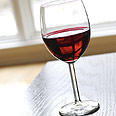
Illustration
צילום: ויז'ואל פוטוס
Art of improvisation: Wine in Lebanon
It may come as a surprise to learn the nominally alcohol-free Arab world provides a new shining star in the winemaking industry
KEFRAYA, Lebanon - Fabrice Guibertau holds a handful of fresh soil to his nose and takes a deep breath. “The ground here is just fantastic,” he says, as the soil glides through his fingers.
Guibertau is an enologist (someone who studies wine and the making of wine) at Château Kefraya, one of Lebanon’s largest wineries. Behind the Frenchman’s back the slopes of the Lebanon mountain range rise up to the sky; in front of him around 100 acres under cultivation stretch into the distance.
The crop area lies in the southern part of Lebanon’s Beqaa Valley, the breadbasket of the country since Roman times. At the same time it’s the stronghold of Hizbullah, the Shiite “Party of God,” led by its general secretary, Hassan Na’srallah, whose followers strictly adhere to a policy of not drinking alcohol.
But from Baalbek in the north of the Beqaa, where most of Hizbullah’s followers live, to Kefraya, it’s around 60 kilometers, and the workers in the vineyards are Muslim as well as Christian.
The cypresses on top of the hill, on which the little castle of Château Kefraya’s founder Michel de Bustros sits, give the area a sense of Tuscany in Italy.
De Bustros started selling wine here in 1979, in the middle of the civil war.
“I fulfilled myself a dream,” the 79-year-old businessman says.
The salon of the castle is covered with awards for the best Kefraya wines. Just last year the “Château Kefraya 2002” won the gold medal at the Concours Mondial de Bruxelles. Years ago, wine-pope Robert Parker in The Advocate rated Kefraya’s Cuvée Prestige “Comte de M,” with 91 out of 100 points.
“We only produce mixtures of different grape varieties,” de Bustros says about his wines, which always sport labels showing the paintings of female Lebanese artists.
Cabernet Sauvignon, Syrah, Merlot, Chardonnay and Muscat Petit Grains are just a few of the grape varieties imported from France.
“Just as artists compose their pictures, we compose our wines, since its production is an art as well,” de Bustros says proudly.
'Nothing can stop the Lebanese'
Wine making is an art with a long tradition in Lebanon. Already in the second century A.D. the Romans erected a temple in Baalbek to honor the wine god Bacchus. But the history of wine growing is even older.
At excavations in the port town Byblos, 5,000-year old grapes were discovered, brought to the Levante by Phoenician merchants who exported them from the Caucasus and Anatolia. In the Middle Ages Venetian merchants exported wines from Tyre and Saida to Europe.
Following the Islamic conquests, though, the vineyard cultivation changed in the land of the cedars. Monks in Christian monasteries on the western fringes of the Beqaa Valley continued the Roman tradition. The best known of these is Ksara, named after a crusader castle, and bought in 1857 from a handful of Jesuits. Last summer its 150th anniversary was celebrated.
Kefraya and Ksara together share about 70 percent of the Lebanese market. Exports are rising, and in countries such as France, Lebanese wines have a long tradition.
Thus, even in times of internal crisis wine growing in Lebanon has stayed true to its history of success and turmoil, just like the history of the country itself.
A quarter of a century ago, in June 1982, Israeli troops moved into the Beqaa Valley just after Syrian positions north of Kefraya had been bombed. De Bustros remembers those stormy days well.
“The Israeli soldiers erected four camps on our vineyards, and the battles against the Syrians took place just around it,” he recalls.
The quality of the wines apparently didn’t suffer: the vintage of 1982 won the silver medal at the competition of Blaye-Bourg in Bordeaux – the first of 200 awards over the decades to follow.
“Nothing can stop the Lebanese,” de Bustros says with a smile, as we sit in the restaurant Dionysos, which belongs to the property.
In 1987, only eight years after having founded the estate, he started exporting, despite all the difficulties of a land at war.
During the months of Israel’s siege of Beirut in 1982, for example, when transport from the capital to the Beqaa Valley was not possible, he shipped corks and bottles via boat from Jounieh to Saida, from where they could be brought over the Shouf Mountains to Kefraya. This was an art of improvisation, making the export of 15,000 bottles possible.
Today, it’s one million bottles a year to 35 countries worldwide.
