


First officer who arrived at scene of J'lem attack criticized
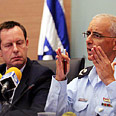
Commander of Jerusalem District Police tells Knesset's Internal Affairs Committee first policeman who arrived at Mercaz Harav yeshiva was 'expected to aim to face shooter'
The terrorist, Alaa Abu Dheim of east Jerusalem, arrived at the yeshiva on a Thursday evening and shot two people standing at the entrance to the building. He then continued to the library and fired at dozens of students without being interrupted.
A policeman who arrived at the yeshiva prevented passerby from entering the building, and the terrorist was eventually shot to death by IDF officer David Shapira, who arrived at the place after hearing the gunshots.
According to Aharon Franco, commander of the Jerusalem District Police, the policeman should have worked to kill the terrorists rather than regulate traffic.
"The first patrol policeman who arrived at the scene first should have aimed to face the terrorist. I expect every officer who knows that there is killing going on to aspire to face the shooter," Franco told the Knesset's Internal Affairs Committee.
He added that "the incident will be studied and the demand to reach contact will be made clear to the officers."
The Knesset members asked whether the officer would face disciplinary measures. Franco replied, "The policeman arrived at a situation, studies the event, and shortly afterwards another officer who was more experienced and professional arrived. The patrol officer says that he was afraid to hurt the yeshiva students."
'Detectives prevented additional killings'
The commander, however, lauded the two officers who arrived at the scene of the attack.
"The detectives arrived at the scene before officer David Shapira. They fired at the terrorist and aimed to reach him, while diverting his attention and preventing him from continuing his killing spree against the yeshiva students.
"Had they not arrived at the place and operated wholeheartedly and while endangering themselves, additional students would have been killed," he said.
The investigation presented to the Knesset revealed that the yeshiva guard acted irresponsibly, did not perform his duty properly and did not work to rescue the yeshiva students.
"According to Franco, "The guard is stationed in the evening at one of the entrances to the yeshiva (a different entrance from that used by the terrorist). He is 61 years old and thought that the gunshots were firecrackers. Even when he was told that the event was a terror attack, he did not leave his post and failed to arrive at the scene of the attack, despite being armed."
The yeshiva secretary, Haim Katz, tried to explain why there was no guard at the entrance to the building.
"We were not obliged by the law to place a guard, as we are a post high school seminary," he said. "There were times when we were demanded to place a guard, and then there was a guard.
"We are not security people and we operate according to the instructions of the security forces. We would like to have an emergency squad to guard the yeshiva, just like in institutions in the Seam Line or in Judea and Samaria."
1,100 calls to police
The investigation into the attack also revealed that the response time at the police call center may have delayed the police's arrival to the scene of the attack. According to the investigation, some 1,100 calls were received at 8:36 pm. A patrol car was dispatched to the area at 8:38 pm, and arrived at the yeshiva two minutes later. The police officers entered the yeshiva at 8:43 pm.
Thousands of the yeshiva students were praying at the Western Wall during the attack. As a result, the number of students at the library where the massacre took place was relatively small.
Knesset Member Ophir Pines-Paz (Labor) told Franco that "this massacre lasted for a long time, and the police response should have been much more overwhelming. I find fault in the fact that you fail to see a problem in the police's conduct and the feeling that you are almost overlooking it."
The police also presented information collected about the terrorist. According to Franco, "The terrorist had a criminal record for car and weapon theft. He was in the process of becoming closer to religion. He recently got engaged, but his fiancé's family said they were unaware of his intentions and condemned the attack when they found out about it."
According to Franco, Abu Dheim arrived at the yeshiva with a Kalashnikov rifle, nine magazines, two pistols and a knife.
