


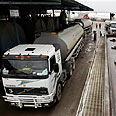
Nahal Oz terminal to reopen Wednesday
Fuel depot closed following terror attack two weeks ago, which left two Israelis dead. For time being, Israel to only allow transfer of diesel to Gaza's power station
For the time being, the defense establishment will only allow the transfer of diesel to the Gaza Strip's power station, while the transfer of petrol will not be possible.
The terminal was partially opened last week for the transfer of diesel and heating gas, but Palestinian gunmen fired at the tankers, leading to a decision to leave the depot closed.
Following the attempted infiltration attack at the Kerem Shalom crossing on Saturday, the defense establishment began looking into the IDF's activity at the crossings.
Sources in Gaza warned Tuesday of the total collapse of all electricity, medical, sanitation, drainage, and other power-related systems in the Strip due to an extreme shortage of fuel.
In addition, the Palestinian Energy Authority (PEA) said that the Palestinian power station would cease to function as of Wednesday.
Several days after it was sealed off following the Palestinian attacks on Gaza's border fence Saturday, the Sufa border crossing in the southern Strip reopened Tuesday morning. Trucks carrying food and medical supplies entered Gaza by noon.
The Erez crossing in northern Gaza, which was closed Monday, also opened later in the day. This crossing mainly serves Palestinian patients entering Israel to receive medical attention.
According to security officials, Hamas' attacks on the border fence are aimed at getting Israel to seal off the crossings, thus worsening the crisis in Gaza and as a consequence attracting the attention, and support, of the international community.
The equipment allowed into Gaza, one official explained, was necessary in order to sustain the Palestinian population.
"This certainly involves difficult dilemmas. On the one hand we don’t want a humanitarian crisis in the Strip or to play into Hamas' hands by contributing to the notion that Israel is to blame for the situation.
"On the other hand, we are dealing with concrete terror threats and are trying to reduce, as much as possible, the risk posed to those operating the crossings," he stated.
