


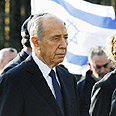
Peres in Poland
צילום מארק ניימן, לע"מ
When Warsaw cried
Tears shed during memorial ceremony give hope that 'new Poland' is possible
If we evaluate President Shimon Peres' recent visit to Poland based on the Polish media coverage, it was clearly an important and highly significant visit.
This time, the visit had another aspect: The ties between Poland and Israel and the support to Israel's positions that Poland is able and willing to offer in the framework of the European Union, including the creation of a united front against Islamic terrorism in general and against the Iranian threat in particular.
Poland's President Lech Kaczynski spared no effort in order to give his guest and the visiting entourage the feeling that Israel has both a partner for the struggle and a friend.
Peres did not shy away from reminding the Poles of their not-so-friendly past when it comes to the Jews. He spoke about the pogroms, the expulsion from the large cities, and also the more "modern" forms of anti-Semitism.
Among other things, Peres noted that in the wake of Word War II, in the summer of 1946, hundreds of Poles including military and police personnel engaged in a pogrom in the Jewish center in Kielce, where more than 100 Jews were brutally murdered. Peres also made note of the 1968 expulsion of about 70,000 Jews.
The Polish hosts, headed by President Kaczynski and Prime Minister Tusk, did everything in order to convince the Israeli president and the entire Israeli nation that those days are over, and that today Poland is a friend and partner. My experience with the Polish public, which goes back dozens of years, makes it difficult for me to believe this.
I believe they do want to and I am aware of their efforts to fight the traditional anti-Semitism prevalent among the Polish masses. However, as long as the popular radio station Radio Marjya, which is both anti-Jewish and anti-Western, continues to operate freely, it is difficult for me to believe that Poland has turned into a "new Poland" or a "different Poland," as we repeatedly heard the country's leaders declare during the visit.
However, the visit, the attitude to the various events, the prevailing atmosphere, and the honor bestowed upon the Israeli president and his entourage certainly served to constitute a drastic change compared to the past. All of this symbolizes the hope that there is a powerful desire to create a "new Poland" in terms of its ties with the Jews.
In the impressive and emotional ceremony at the Rapoport Monument to mark 65 years to the Warsaw Ghetto uprising, attended by thousands of Poles even though it took place during a weekday, I saw quite a few residents who shed a tear when the "El Maleh Rachamim" prayer was sang by the cantor.
Even without understanding a word, they knew that the cantor was bemoaning the victims of the Holocaust on behalf of all Jewry. And if there are Poles like that too, we can certainly believe that there is a chance for a "different Poland."
