


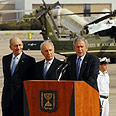
Bush with Olmert and Peres in recent visit
צילום: איי אף פי
US: Timing not right for three-way Mideast meeting
White House says Bush's second trip to region this year will not see him hosting joint session with Israeli and Palestinian leaders. 'It just doesn't feel right as the best way to advance the negotiation,' National Security Advisor Stephen Hadley notes
US President George W. Bush's second trip to the Mideast this year, designed in part to make progress toward a peace deal before the end of his presidency, will not see him hosting a joint session with the leaders of Israel and the Palestinian Authority, the White House said.
"This did not seem the time for a big, high-level, three-way event," Stephen Hadley, Bush's national security adviser, told reporters on Wednesday. "It just doesn't feel right as the best way to advance the negotiation."
Bush has set a goal of shepherding an Israeli-Palestinian accord before he leaves office in January and has stepped into Mideast peacemaking at a level not previously seen in his presidency. But after launching in November the first substantive peace talks between the two sides in more than seven years, hopes that started out moderately high have dimmed considerably.
Even Bush's once-unfailingly optimistic language on the peace process has become more tempered of late. And the lack of a three-way meeting between him, Prime Minister Ehud Olmert and Palestinian President Mahmoud Abbas - after on-again, off-again talk that one might be in the offing for this trip - seemed an ominous sign.
The primary purpose of the president's five-day trip to Israel, Saudi Arabia and Egypt, a follow-up to his trip to the same three countries and others in the region in January, is ceremonial. He is marking the 60th anniversary of Israel's creation and 75 years of US relations with Saudi Arabia.
Bush also has plenty of official business on his plate. He delivers speeches before the Knesset, the Israeli parliament, and at the World Economic Forum in the Middle East, a gathering of hundreds of global policymakers and business leaders being held in Sharm el-Sheik, Egypt. Also while in the Red Sea resort for two days, Bush is meeting with a string of leaders key to US goals in the region:
'Symbolic and substantive'
Abbas and Palestinian Prime Minister Salam Fayyad, as well as Egyptian President Hosni Mubarak, Afghan President Hamid Karzai, Jordan's King Abdullah II, Lebanese Prime Minister Fouad Siniora and Iraqi leaders."It's both symbolic and substantive," Hadley said of Bush's trip, which starts Tuesday.
While in Jerusalem, Bush will hold talks with Olmert and President Shimon Peres in addition to attending a conference marking the Israeli anniversary and throwing a reception in honor of it. The White House decision for the president to see Abbas only while in Egypt, and not on another visit to the Palestinian territories, raised eyebrows with Palestinians - especially given the lavish attention being paid to the founding of the Jewish state.
"We are, in some sense, all over this process, both in Israel and in terms of the West Bank," Hadley said. "And I think it just made sense in terms of the president's scheduling and given the messages and the themes we wanted to strike, this seemed to be a good way to accomplish what we are trying to accomplish with the trip."
Both sides in the decades-long Israeli-Palestinian dispute have failed to take basic trust-building steps considered necessary for successful negotiations to move forward on the stickiest matters: the borders of a Palestinian state, the future of Jerusalem and the fate of refugees with claims to Jewish land.
The seizure of control of the Gaza Strip by the militant group Hamas and from Abbas is a particularly difficult factor in talks.
But Hadley said it doesn't preclude an agreement. "The door has been opened to Hamas to become part of this process. They have refused to do so," He said. "The Palestinian Authority has decided to go forward and negotiate with Israel."
